
Contents
Manufacturing Insight: Titanium Vs Steel Weight
Material Selection Impact on Weight-Critical Applications
When engineering components for aerospace, medical, or high-performance automotive systems, the weight differential between titanium and steel directly influences functionality, fuel efficiency, and lifecycle costs. Titanium alloys offer a compelling density advantage at approximately 4.5 g/cm³—nearly 45% lighter than 304 stainless steel (7.9 g/cm³)—while maintaining comparable strength-to-weight ratios and superior corrosion resistance. However, steel remains advantageous for applications prioritizing wear resistance, magnetic properties, or cost efficiency in non-weight-sensitive assemblies. This trade-off demands precise machining expertise to realize theoretical material benefits in final part performance.
At Honyo Prototype, our CNC machining capabilities are optimized for both material families, leveraging advanced 5-axis milling and turning centers to achieve tight tolerances (±0.005mm) and exceptional surface finishes. We mitigate titanium’s challenges—such as low thermal conductivity and work-hardening tendencies—through specialized toolpath strategies and coolant management, while maximizing steel’s machinability for high-volume production runs. Material choice should never compromise manufacturability; our engineering team collaborates early in your design phase to validate geometry feasibility and recommend optimal stock-to-part transitions.
Accelerate your prototyping timeline with Honyo’s Online Instant Quote platform. Upload CAD files to receive manufacturability feedback and competitive pricing within hours—not days—ensuring informed material decisions align with your project’s weight, timeline, and budget constraints.
Technical Capabilities
Titanium and steel are commonly used in precision machining applications such as 3-axis, 4-axis, and 5-axis milling, as well as CNC turning, especially when tight tolerances (±0.0005″ or tighter) are required. Weight is a critical factor in aerospace, medical, and high-performance automotive industries, where part performance and lifecycle are sensitive to mass and strength-to-density ratios. Below is a comparison of titanium and steel relative to other common materials used in these processes.
| Material | Density (g/cm³) | Tensile Strength (MPa) | Typical Machinability Rating | Weight Comparison (vs Steel) | Common Use in Precision Machining | Suitability for Tight Tolerance Work |
|---|---|---|---|---|---|---|
| Titanium (Grade 5, Ti-6Al-4V) | 4.43 | 900–950 | Poor to Moderate | ~56% of steel | Aerospace, medical implants, racing components | Good (with proper tooling and coolant) |
| Steel (4140 Alloy) | 7.85 | 850–1000 | Moderate | 100% (baseline) | Tooling, shafts, high-strength fixtures | Excellent (dimensional stability) |
| Aluminum (6061-T6) | 2.70 | 310 | Excellent | ~34% of steel | Enclosures, prototypes, heat sinks | Excellent (easy to hold tight tolerances) |
| ABS (Acrylonitrile Butadiene Styrene) | 1.04 | 40–45 | Very Good | ~13% of steel | Prototypes, jigs, non-structural parts | Good (low thermal stability affects precision) |
| Nylon (PA6/PA66) | 1.13 | 70–80 | Good | ~14% of steel | Bearings, insulators, low-friction parts | Moderate (hygroscopic; dimensional changes) |
Technical Notes on Machining and Tolerances:
In 3/4/5-axis milling and turning operations, material density directly affects tool wear, cutting forces, and spindle load. Titanium, despite being significantly lighter than steel, is harder on tooling due to its low thermal conductivity and tendency to gall. This necessitates slower cutting speeds, specialized carbide or coated tools, and high-pressure coolant for tight tolerance work.
Steel offers superior dimensional stability and surface finish under high-precision machining, making it ideal for master gauges, molds, and structural components requiring long-term repeatability. However, its higher weight may be a drawback in weight-sensitive assemblies.
Aluminum is often preferred for rapid prototyping and lightweight precision parts due to its excellent machinability and low mass. It holds tight tolerances well but lacks the strength and wear resistance of steel or titanium in high-stress environments.
Engineering plastics like ABS and Nylon are used in non-structural precision components where weight reduction and electrical insulation are priorities. However, their lower stiffness and sensitivity to moisture and temperature require careful fixturing and environmental control to maintain tight tolerances.
In summary, while titanium provides a favorable strength-to-weight ratio over steel, it demands more rigorous machining parameters. Material selection should balance weight requirements, mechanical performance, and manufacturability within the context of multi-axis CNC processes and tolerance specifications.
From CAD to Part: The Process
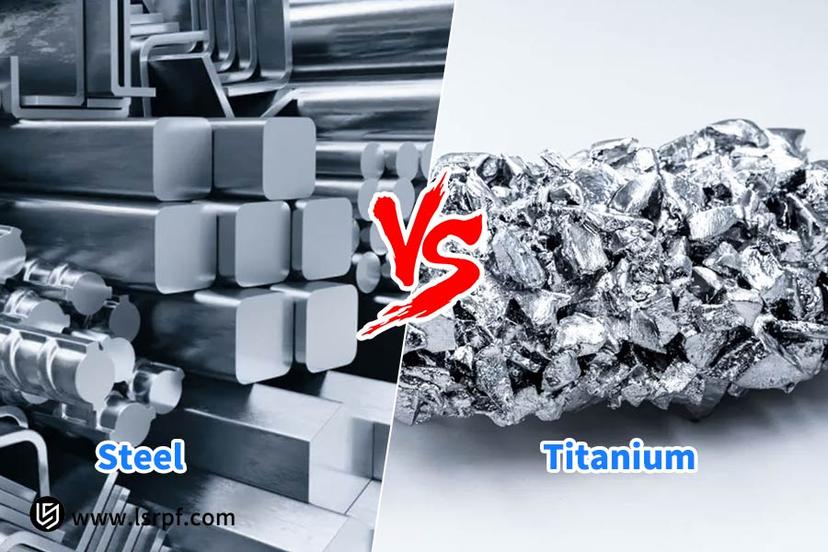
Honyo Prototype executes precise material weight comparisons between titanium and steel through a structured, technology-integrated workflow designed for engineering accuracy and manufacturability validation. Our process begins when the client uploads their CAD model to our secure portal. The native geometry data undergoes automated parsing to extract critical parameters including volume, wall thickness, and feature complexity. This raw geometric data forms the foundation for subsequent material-specific analysis.
The AI Quote engine then processes the CAD geometry against our proprietary material database containing certified density values for aerospace-grade titanium alloys (e.g., Ti-6Al-4V: 4.43 g/cm³) and engineering steels (e.g., 304 stainless: 7.93 g/cm³, 4140 alloy: 7.85 g/cm³). The system calculates theoretical weight differentials by applying material densities to the component volume, generating instant comparative metrics. Crucially, this phase includes manufacturability flags—such as titanium’s lower thermal conductivity potentially requiring slower machining rates or steel’s higher hardness affecting tool wear—that influence final production weight through tolerance considerations.
During DFM analysis, our engineering team reviews the AI output with material-specific expertise. We assess whether the design leverages titanium’s strength-to-weight advantage effectively or if steel’s higher density necessitates structural modifications that could alter weight outcomes. For instance, a thin-walled titanium part might maintain integrity where steel would require reinforcement, partially offsetting theoretical weight savings. Our DFM report explicitly documents revised weight projections based on necessary design adjustments, material removal rates, and post-processing allowances like anodization thickness for titanium.
In Production, weight validation becomes empirical. Each material variant undergoes first-article inspection using calibrated scales traceable to NIST standards. Machining parameters are optimized per material: titanium requires lower cutting speeds with rigid setups to prevent work hardening, while steel allows higher MRR but demands precise coolant control to avoid thermal distortion. We record actual part weights at multiple stages—pre-machining billet, post-machining, and post-finishing—to quantify processing effects. This data feeds directly into our quality documentation.
Final delivery includes a comprehensive material comparison dossier showing CAD-derived theoretical weights, DFM-adjusted projections, and certified actual weights from production. The package contains certified material test reports (CMTRs) verifying alloy composition and density, along with dimensional inspection data proving tolerance compliance. This end-to-end traceability ensures clients receive not just physical parts but validated engineering data to inform their material selection decisions for volume production. All weight metrics are presented with measurement uncertainty values per ISO/IEC 17025 requirements.
Start Your Project
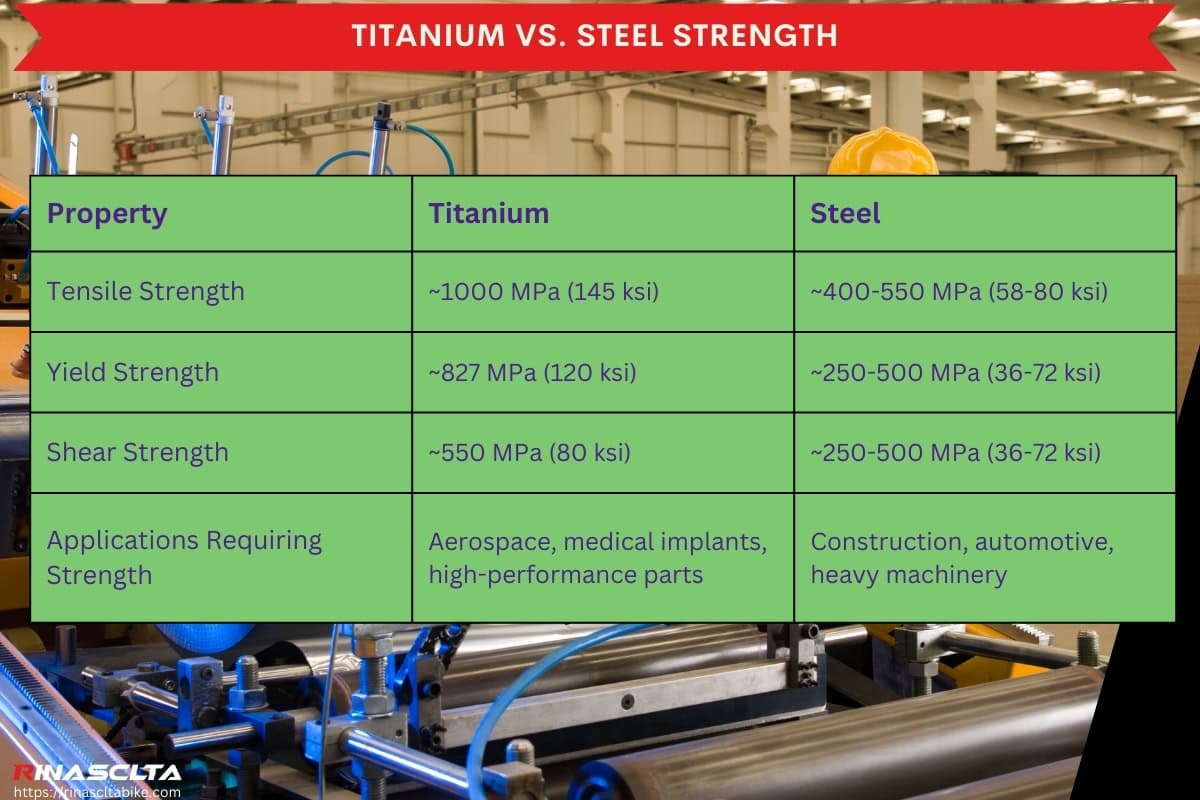
When comparing titanium versus steel for weight-critical applications, material selection directly impacts performance, durability, and cost. Titanium offers a superior strength-to-density ratio, making it ideal for aerospace, medical, and high-performance automotive components where weight reduction is crucial. Stainless steel, while denser, provides higher strength in certain grades and better wear resistance—making it suitable for different operational environments.
Understanding the trade-offs between titanium and steel weight, corrosion resistance, and lifecycle costs is essential in prototyping and production. For custom components, material evaluation, and DFM support, contact Susan Leo at [email protected]. With our ISO-certified factory located in Shenzhen, Honyo Prototype delivers precision CNC machining, rapid prototyping, and low-volume production with strict quality control and fast turnaround. Let us help you select the right material and process for your next project.
🚀 Rapid Prototyping Estimator
Estimate rough cost index based on volume.