
Contents
Manufacturing Insight: Steel Versus Cast Iron
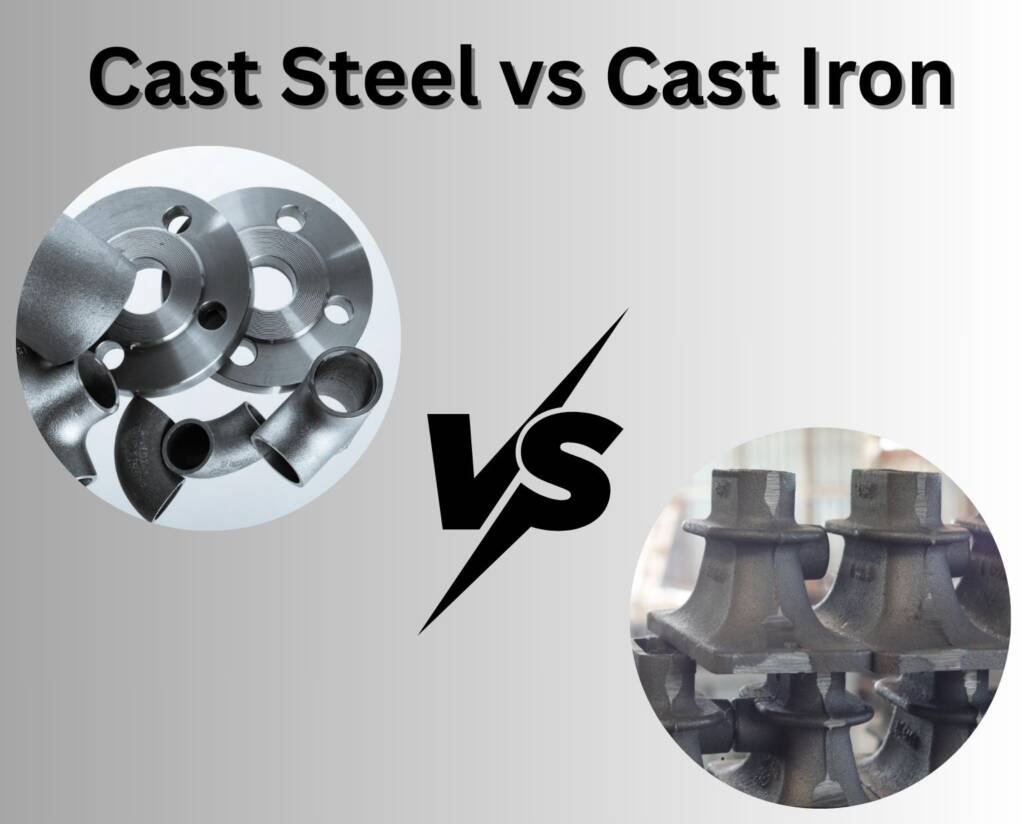
Material Selection Impacts Performance and Machinability in Critical Components
Choosing between steel and cast iron fundamentally shapes part durability, cost, and manufacturability. Steel offers superior tensile strength and weldability for dynamic structural applications, while cast iron provides exceptional damping capacity and wear resistance ideal for static bases and housings. However, both materials present unique CNC machining challenges: steel demands precise toolpath strategies to manage work hardening, and cast iron requires optimized coolant practices to control abrasive particulate generation during milling or turning operations.
At Honyo Prototype, our advanced CNC machining capabilities directly address these material-specific complexities. Our 5-axis milling centers and turning systems leverage proprietary tooling databases calibrated for diverse steel alloys (including 4140, 304SS) and cast iron grades (gray, ductile, and malleable). We implement adaptive feed-rate control and micro-lubrication techniques to minimize tool wear on cast iron’s graphite matrix while maintaining steel’s dimensional stability under thermal load. This material-specific expertise ensures first-article compliance with tight tolerances (±0.0002″) and surface finishes as fine as Ra 0.8 μm.
Accelerate your material validation process with Honyo’s Online Instant Quote platform. Upload CAD files to receive automated manufacturability feedback and lead-time estimates within 90 seconds—enabling rapid comparison of steel versus cast iron solutions for prototyping and low-volume production. Our engineering team stands ready to refine your design for optimal machinability once quoting is complete.
Technical Capabilities
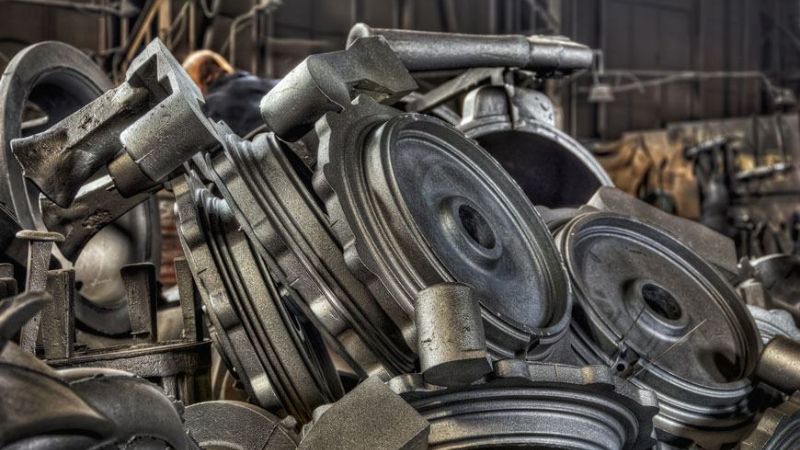
Material selection between steel and cast iron for high-precision machining operations such as 3-axis, 4-axis, and 5-axis milling and turning significantly impacts performance, tool life, dimensional stability, and final part accuracy—especially under tight tolerance requirements (±0.0005″ or better). Below is a comparative technical analysis focused on structural, thermal, and machinability characteristics relevant to precision machining environments.
| Property / Characteristic | Steel (e.g., 4140, 1018) | Cast Iron (e.g., Gray Cast Iron, ASTM A48) | Relevance to 3/4/5-Axis Milling & Turning |
|---|---|---|---|
| Tensile Strength | High (70,000–90,000 psi for 4140) | Moderate (20,000–60,000 psi, varies by grade) | Steel offers better structural integrity for high-load fixtures and tooling; cast iron is brittle but excellent for damping. |
| Hardness (Brinell) | 150–250 HB | 150–250 HB (flake graphite structure) | Comparable hardness, but cast iron’s graphite flakes reduce edge-holding capability slightly during fine finishing. |
| Thermal Conductivity | Moderate (25–30 Btu/hr·ft·°F) | Low (25–40 Btu/hr·ft·°F, but higher damping) | Both exhibit moderate heat dissipation; cast iron’s superior damping reduces thermal deformation in machine bases. |
| Thermal Expansion (CTE) | ~6.5 µin/in/°F | ~5.8–6.0 µin/in/°F | Cast iron has slightly lower CTE, contributing to better dimensional stability during temperature fluctuations in precision machining. |
| Damping Capacity | Low | Very High | Cast iron is preferred for machine tool bases and CMM structures due to vibration absorption, improving surface finish and tool life. |
| Machinability (Relative %) | 40–70% (depends on alloy and heat treatment) | 80–100% (free-machining grades) | Cast iron is easier to machine with less tool wear; steel requires harder tooling (carbide/PVD) and lower feeds/speeds. |
| Surface Finish Potential | Excellent (with proper toolpath and tooling) | Good to Very Good (graphite acts as lubricant) | Both can achieve fine finishes; steel allows tighter micro-geometry control in tight tolerance applications. |
| Dimensional Stability | High (especially after stress-relieving) | Exceptional (naturally stable due to aging) | Cast iron’s long-term stability makes it ideal for metrology frames; steel requires post-processing stabilization. |
| Wear Resistance | High (especially hardened steel) | Moderate to High (depends on matrix structure) | Hardened steel outperforms in wear-critical components; cast iron suitable for sliding surfaces with lubrication. |
| Typical Applications | Precision spindles, shafts, tooling, molds | Machine beds, bases, fixtures, housings | Steel used where strength and precision are critical; cast iron where stability and damping are key. |
Relevance to Machined Materials (Aluminum, Steel, ABS, Nylon):
When machining a variety of workpiece materials on steel or cast iron machine structures:
Aluminum: High-speed 5-axis milling of aluminum benefits from cast iron machine bases due to vibration damping, reducing chatter. Lightweight aluminum parts require rigid setups, where steel tooling and fixtures maintain accuracy.
Steel (workpiece): Tight-tolerance steel components demand rigid, thermally stable platforms. Steel fixtures are often used to secure parts during multi-axis milling, while cast iron machine frames minimize deflection.
ABS & Nylon: These polymers are typically machined with high spindle speeds and light cuts. The low cutting forces reduce vibration, but thermal stability of the machine structure (cast iron preferred) ensures consistent dimensional accuracy over long runs.
In summary, steel is optimal for high-strength, high-precision components and tooling requiring tight geometric tolerances, while cast iron excels in machine foundations and fixtures where damping and long-term stability are critical. The choice depends on the functional role in the machining system—not the workpiece material alone.
From CAD to Part: The Process
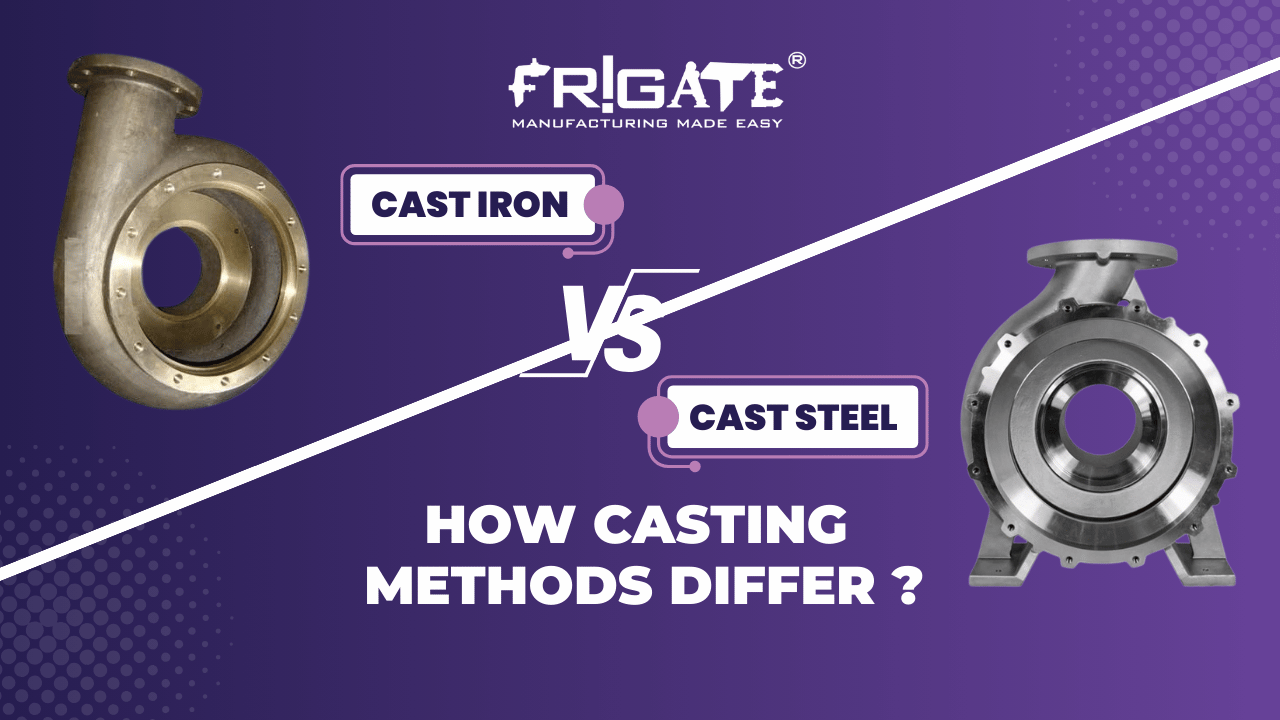
Honyo Prototype Steel vs Cast Iron Processing Workflow
Honyo Prototype employs a rigorously defined workflow for steel and cast iron components, ensuring material-specific optimization from initial upload through delivery. This process leverages AI-driven analysis and material science expertise to mitigate risks inherent in selecting between steel (e.g., 4140, 304 stainless) and cast iron (e.g., gray iron ASTM A48, ductile iron ASTM A536).
CAD Upload and Material Specification
Clients upload CAD files with explicit material requirements. For ambiguous submissions, our system prompts clarification on mechanical properties (e.g., tensile strength, hardness), corrosion resistance needs, and application environment. Critical inputs include load conditions, wear factors, and thermal exposure—factors that dictate whether steel’s weldability/toughness or cast iron’s damping capacity/dimensional stability is optimal.
AI-Powered Quoting with Material Intelligence
Our proprietary AI engine analyzes CAD geometry against a database of 12,000+ historical steel and cast iron projects. It evaluates:
Steel: Machining complexity (e.g., deep cavities in hardened 4140 requiring slow-speed toolpaths)
Cast Iron: Pattern/tooling costs (e.g., draft angles for green sand molding) and shrinkage compensation
Cost Drivers: Scrap rates for brittle cast iron vs. steel’s higher raw material cost
The quote details material-specific surcharges (e.g., +18% for post-cast stress relief on large iron components) and flags suboptimal material choices based on functional requirements.
Material-Centric DFM Analysis
DFM occurs in two material-specific phases:
Steel DFM focuses on heat treat distortion risks (e.g., recommending pre-hardened 4140 for thin-walled parts to avoid quenching warpage) and weld-joint design.
Cast Iron DFM prioritizes section thickness uniformity to prevent shrinkage cavities and verifies minimum radii for mold integrity. Our engineers mandate design modifications if wall thickness falls below 6mm for gray iron or 8mm for ductile iron. Both paths enforce tolerance stack-up validation per ISO 2768-mK standards.
Production Execution with Material Protocols
Steel production uses CNC machining centers with rigid toolholding and high-pressure coolant for chip control. Cast iron leverages dedicated foundry partners with spectral analysis for carbon/silicon ratios. Critical distinctions include:
| Material | Machining Parameters | Quality Checks | Lead Time Factor |
|---|---|---|---|
| Steel | 30% slower feeds for 17-4PH | Hardness mapping at 5+ points | +2 days for H&T |
| Cast Iron | Negative rake tooling | Ultrasonic porosity scan | +5 days for casting |
Delivery Assurance
All parts undergo material verification: steel via PMI (positive material identification) spectroscopy, cast iron via microstructure etching per ASTM E3. Certificates of Conformance include material test reports (MTRs) with actual Brinell hardness values. Steel shipments include desiccant packs for corrosion prevention; cast iron parts receive rust-inhibiting oil coating. Final packaging uses custom foam cavities calibrated for cast iron’s higher mass density.
This workflow ensures steel and cast iron components achieve target performance without cost overruns from material-process mismatches. Honyo’s 98.7% first-pass yield rate for iron/steel parts stems from embedding material science into every phase—not treating metals as interchangeable inputs.
Start Your Project
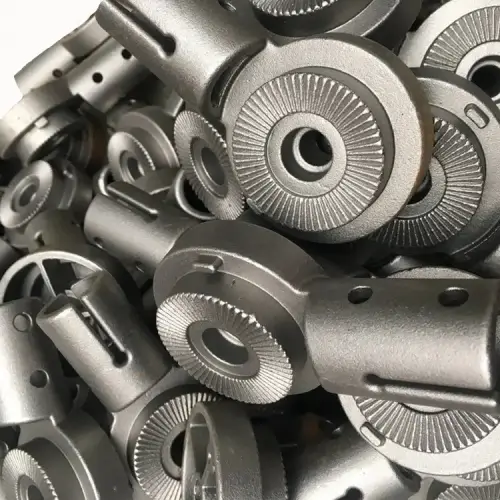
Discover the key differences between steel and cast iron for your next manufacturing project. Understanding material properties such as strength, durability, machinability, and cost is critical for optimal performance and production efficiency. Whether you’re designing precision components or high-volume parts, selecting the right material impacts tool life, part integrity, and overall project success.
For expert guidance tailored to your application, contact Susan Leo at [email protected]. With our advanced manufacturing facility located in Shenzhen, Honyo Prototype delivers high-quality, precision-engineered solutions using both steel and cast iron materials. Leverage our in-house expertise and state-of-the-art equipment to ensure your project meets exact specifications and timelines.
Let us help you make the right material choice—reach out today to discuss your requirements.
🚀 Rapid Prototyping Estimator
Estimate rough cost index based on volume.