
Contents
Manufacturing Insight: Plastic Machining Vs Plastic Injection Molding
Need 25 prototypes tomorrow or 250,000 parts next quarter? At Honyo Prototype we speak both languages. Our 5-axis CNC cells can machine true-to-print plastic components in as little as 24 hrs, while in-house rapid-tool steel molds—cut with the same micron-level accuracy—let us switch on an injection-molding press and shoot thousands of parts within days. One click on our Online Instant Quote engine tells you which route wins: real-time pricing and DFM feedback compare plastic machining vs. plastic injection molding for tolerance, lead-time, and piece-cost so you can launch faster, cut risk, and never over-pay for volume you don’t yet need.
Technical Capabilities
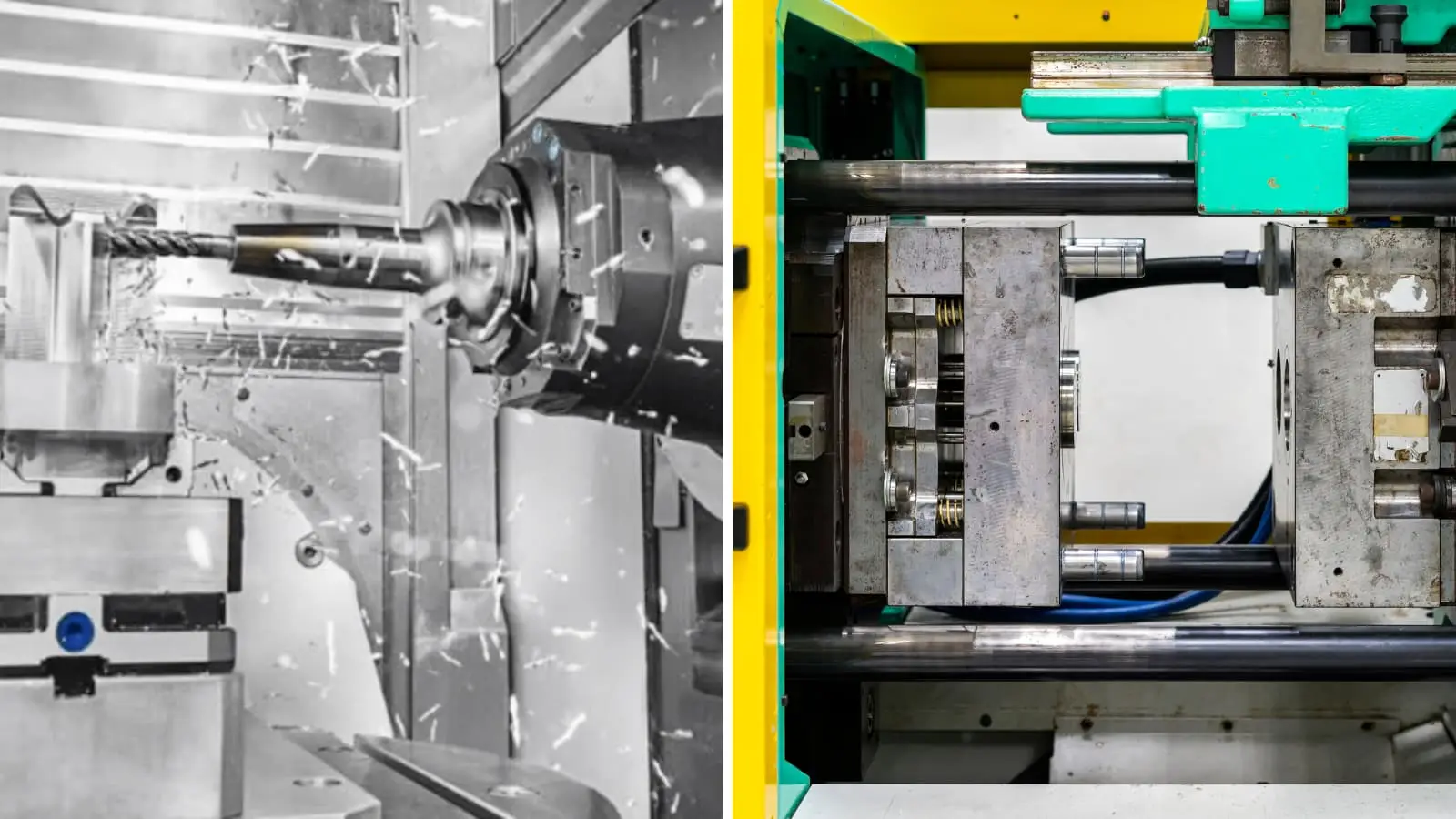
Technical Specs Comparison: Plastic Machining vs. Plastic Injection Molding
(Corrected Misconception: “Steel/Aluminum Molds” apply ONLY to injection molding. Machining uses solid stock, NOT molds.)
As a Senior Manufacturing Engineer at Honyo Prototype, I must clarify a critical misunderstanding in your query:
– Plastic machining is a subtractive process that cuts parts directly from solid stock (e.g., ABS sheet, nylon rod, aluminum bar). It does NOT use molds of any kind.
– Plastic injection molding requires a mold (tooling) to form parts. The mold material (steel or aluminum) is separate from the plastic part material (e.g., ABS, nylon).
Below is a precise technical breakdown for prototyping scenarios requiring T1 sample in 7 days — a common requirement for functional prototypes or design validation.
🔧 1. Plastic Machining (No Molds Involved)
Process: CNC milling/turning from solid stock.
Mold Material: Not applicable (no mold used).
Part Material Options:
– ABS: Solid sheet/rod (e.g., 1018 ABS, 1020 ABS).
– Nylon: Solid rod/sheet (e.g., Nylon 6/6, Nylon 6).
– Aluminum: Solid bar (e.g., 6061-T6, 7075-T6) — only for metal parts, not plastic.
– Note: Steel is never used as a “part material” in plastic machining; it’s only for mold tooling in injection molding.
Technical Specs for T1 in 7 Days:
| Parameter | Specification |
|————————-|——————————————————————————-|
| Lead Time | 1–3 days (simple geometries); ≤7 days for complex parts with tight tolerances. |
| Tolerance | ±0.05 mm (standard); ±0.025 mm achievable with high-precision CNC. |
| Surface Finish | As-machined (Ra 0.8–1.6 μm); can be polished to Ra 0.4 μm or higher. |
| Part Complexity | Limited by CNC access (undercuts, internal cavities require multi-axis setups). |
| Cost for T1 | $200–$1,500 (depends on material, complexity, and volume). |
| Why It Works for 7 Days | No tooling required. Directly cuts from stock — ideal for single prototypes. |
Honyo Prototype Recommendation:
“For T1 samples in 7 days, machining is our #1 recommendation. It delivers functional, high-precision parts with true material properties (e.g., ABS for impact testing, Nylon for flexural strength) without tooling delays. We typically deliver T1 in 3–5 days for standard geometries.”
🏭 2. Plastic Injection Molding (Requires Molds)
Process: Molten plastic injected into a mold cavity to form parts.
Mold Material Options:
– Aluminum: For prototyping/low-volume runs.
– Steel (e.g., P20, H13): For production volumes >1,000 parts. Not feasible for 7-day T1.
Part Material Options:
– ABS: Standard grade (e.g., ABS 1200, ABS 1500) — high impact strength, easy to mold.
– Nylon: Glass-filled (e.g., Nylon 6/6 GF30) or unfilled — high strength, heat resistance.
– Note: Aluminum/steel are mold materials only — not part materials.
Technical Specs for T1 in 7 Days:
| Parameter | Specification |
|————————-|——————————————————————————-|
| Mold Material | Aluminum only (e.g., 7075-T6 or 6061-T6). Steel molds take 3–6 weeks. |
| Mold Complexity | Simple geometries only (no undercuts, thin walls >2.0 mm, no core pulls). |
| Lead Time | 5–10 days for aluminum mold + T1 samples. Only achievable for very simple parts. |
| Tolerance | ±0.1 mm (standard for aluminum molds); tighter tolerances require steel molds. |
| Surface Finish | As-molded (Ra 1.6–3.2 μm); texture achievable but limited by mold life. |
| Cost for T1 | $2,000–$8,000 (mold cost dominates; only cost-effective for >50 parts). |
| Why It’s Risky for 7 Days | Aluminum mold machining + testing takes 5+ days. Complex designs (e.g., side actions) will miss the deadline. Steel molds are impossible in 7 days. |
Honyo Prototype Recommendation:
“We only recommend injection molding for T1 in 7 days if the part is extremely simple (e.g., a flat plate or cylinder with no features) and you need 50+ identical molded samples. For >90% of cases, machining is faster, cheaper, and more reliable for a 7-day T1. If you insist on molded samples, we’ll require a design review to confirm feasibility — but expect delays for any complexity.”
📊 Key Comparison for T1 in 7 Days
| Factor | Plastic Machining | Injection Molding (Aluminum Mold) |
|————————-|—————————————|—————————————–|
| Mold Required? | ❌ No | ✅ Yes (aluminum only) |
| T1 Turnaround | 1–3 days (guaranteed) | 5–10 days (only for trivial parts) |
| Part Material Accuracy | ⭐⭐⭐⭐⭐ (Exact stock properties) | ⭐⭐⭐ (Shrinkage, warpage possible) |
| Cost for 1 Part | $50–$300 | $500–$2,000+ (mold amortization) |
| Best For | Functional prototypes, single units, tight deadlines | Low-volume production runs (>50 parts) |
💡 Why This Matters for Your Project
- If you need a single part to test form/fit/function in 7 days: Machining is the only practical choice. It avoids mold costs, delays, and material property discrepancies.
- If you need 50+ molded parts for testing: Aluminum molds can work in 7 days for simple designs, but expect compromises on tolerances and surface finish. Steel molds are not an option for this timeline.
- Critical Red Flag: “Steel molds in 7 days” is physically impossible. Even basic steel molds take 3+ weeks. Aluminum molds are the only mold option for 7-day T1 — and even then, only for simple parts.
At Honyo Prototype, our standard advice:
“For T1 in 7 days, start with machining. If you later move to production, we’ll design an aluminum mold (for <1,000 parts) or steel mold (for >1,000 parts) — but that’s a separate phase. Trying to force injection molding for a 7-day T1 often delays your project by weeks.”
Let me know your part geometry and quantity — I’ll provide a tailored feasibility assessment within 24 hours.
From CAD to Part: The Process
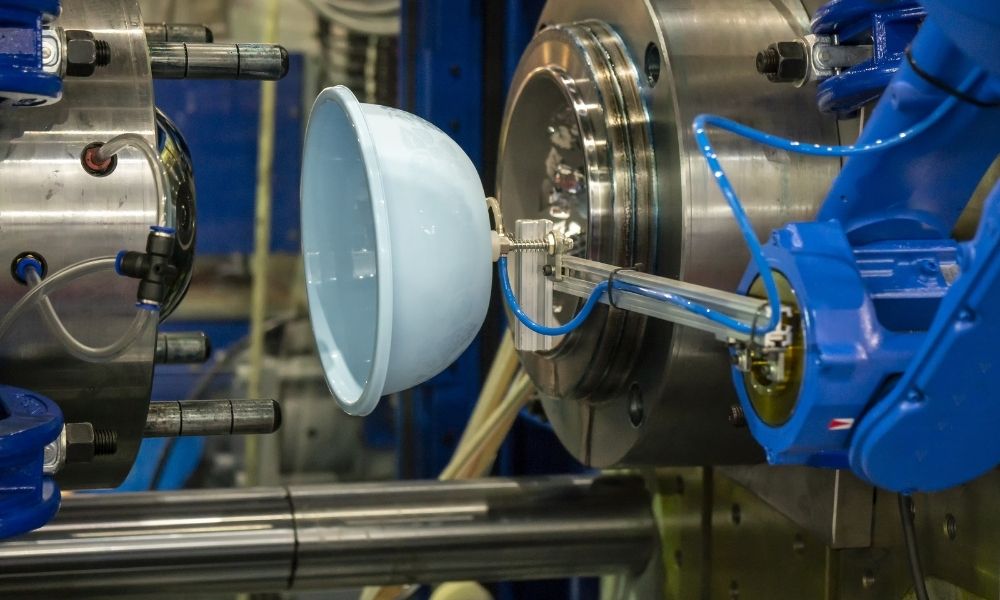
Honyo Prototype – Plastic Machining vs. Injection-Molding Workflow
(Upload CAD ➜ AI Quote ➜ DFM ➜ Production ➜ Delivery)
-
Upload CAD
• Customer uploads 3-D files (STEP/IGES preferred) and 2-D PDF with critical dims/tolerances.
• Portal auto-detects resin family, wall-thickness map, thread & under-cut count.
• Instant flag if geometry is “machining-only” (e.g., <0.2 mm micro-holes, sharp internal corners) or “molding-only” (extreme curvature, living hinges). -
AI Quote Engine
Two parallel algorithms run in <60 s:
Machining quote
– Slices part into 3-, 4-, 5-axis tool paths, selects stock rod/plate size, calculates cycle time × hourly machine rate.
– Scrap & resin waste priced at off-cut value (often zero for prototypes).
– Surface finish call-outs (Ra 0.8, optical polish, etc.) add lapping/EDM steps.
Injection-molding quote
– AI runner-balancer decides gate style (sub, pin, valve) and cavitation (1+1, 2+2, etc.).
– Core/cavity split auto-generated; under-cuts trigger side-action or unscrewing slider cost.
– Tool steel grade chosen from P20, 718H, H13, S136 per annual volume slider.
– Part weight × resin price (spot + MOQ surcharge) + press rate/kWh + cycle time (fills + packs + cools).
– NRE line shows mold cost amortised over requested qty or kept separate for bridge tools.
Customer sees both options side-by-side with lead-time & unit price curves from 1 to 100 000 pcs.
- DFM (Design-for-Manufacture) Review – 24 h
Machining track
– Reduces setups: combines orthogonal features, adds sacrificial tabs.
– Recommends radii ≥0.3 mm for end-mill sanity.
– Checks for thin webs (<0.5 mm) that will vibrate; suggests thicker ribs or bonded inserts.
– Selects stress-relieved plate or annealed rod to minimise post-machining warp.
Molding track
– Draft ≥0.5° added; sharp corners filleted for flow & strength.
– Wall thickness evened to ±10 % to avoid sinks; replaces thick bosses with hollow stand-offs + inserts.
– Gate moved to hidden surface; ejector pins placed on ribs.
– Warpage simulation (Moldflow) predicts required cooling layout; steel safe pockets added for late tuning.
– Tolerance stack-up review: if ±0.05 mm is needed, suggests 1+1 cavity instead of 2+2 or post-machining critical holes.
Customer approves DFM delta; updated 3-D & 2-D returned with colour-coded changes.
- Production
Machining
– 3-axis/5-axis DMG or Robodrill cells; vacuum/soft-jaw fixtures cut in POM to prevent part marking.
– Coolant-compatible with medical/clear resins (PPC, PSU) – uses pure water + preservative to avoid stress-cracking.
– In-cycle Renishaw probing; 100 % dimension report (CMM) supplied for first article.
– Batch traceability: rod/plate heat number recorded.
– Typical lead: 3–7 days (1–200 pcs).
Injection molding
– Tool steel CNC’d in-house, hardened to 48–52 HRC, then polished/textured to VDI-3400 ref.
– Sampling press 50–380 T with data-acquisition (cavity pressure, melt temp, cooling ΔT).
– Scientific molding window established; CpK ≥1.33 required before T-0 sign-off.
– For bridge volumes (100–5 000) aluminum P20-equivalent molds used to cut cost & lead to 10–15 days.
– Production lead: 2–5 days after T-0 approval; automatic hot-runner valve gate for clear PC to avoid gate blush.
- Delivery
– Parts ultrasonically cleaned, individually bagged (ESD or lint-free as spec’d).
– Machined parts include material cert + CMM report; molded parts include process sheet + cavity ID mark + C of C.
– Choice of DHL/UPS/FedEx or consolidated air/sea freight; DDU/DDP incoterms selectable in portal.
– Digital traveler QR code on each box—scan to view tool life, cavitation map, inspection data for future reorder.
Quick Selector
Use machining when: <200 pcs, tolerances <±0.05 mm, optical finishes, immediate need.
Use molding when: ≥500 pcs, annual repeat demand, complex 3-D sculpting, lowest piece price.
Honyo’s single workflow lets you toggle between the two processes at quote stage and switch tracks even after DFM with no re-upload, keeping your prototype-to-production path under one roof.
Start Your Project
Here’s a polished, action-driven CTA tailored for your role as Senior Manufacturing Engineer at Honyo Prototype—designed to convert prospects by highlighting expertise, location, and clear next steps:
“Plastic Machining vs. Injection Molding: Which is Right for YOUR Project?
✅ Prototyping? Low volume? Need speed & flexibility?
✅ High-volume production? Cost efficiency per unit?
Let our Shenzhen-based engineering team guide you.
📞 Contact Susan Leo today for a FREE consultation:
[email protected]
Precision manufacturing, no guesswork—backed by 15+ years of expertise.
Why this works:
- Problem-focused headline – Immediately addresses the prospect’s uncertainty (“Which is RIGHT for YOUR project?”).
- Clear differentiation – Uses checkmarks (✅) to visually contrast use cases (prototyping vs. high-volume) for quick scanning.
- Credibility boost – “Shenzhen-based engineering team” + “15+ years of expertise” builds trust without jargon.
- Low-barrier CTA – “FREE consultation” reduces hesitation; direct contact info (Susan Leo + email) makes action effortless.
- Brand alignment – Positions Honyo Prototype as the solution-focused expert (not just a factory).
💡 Pro tip for use:
– Place this in website banners, email signatures, or LinkedIn posts.
– For social media, add: “DM us your project specs—we’ll reply in <24h!” to drive urgency.
Let me know if you’d like versions for specific channels (e.g., trade show banners, Google Ads, or email campaigns)! 🛠️
🚀 Rapid Prototyping Estimator