
Contents
Manufacturing Insight: Is Titanium Cheaper Than Stainless Steel
Material Cost Realities in Precision Manufacturing
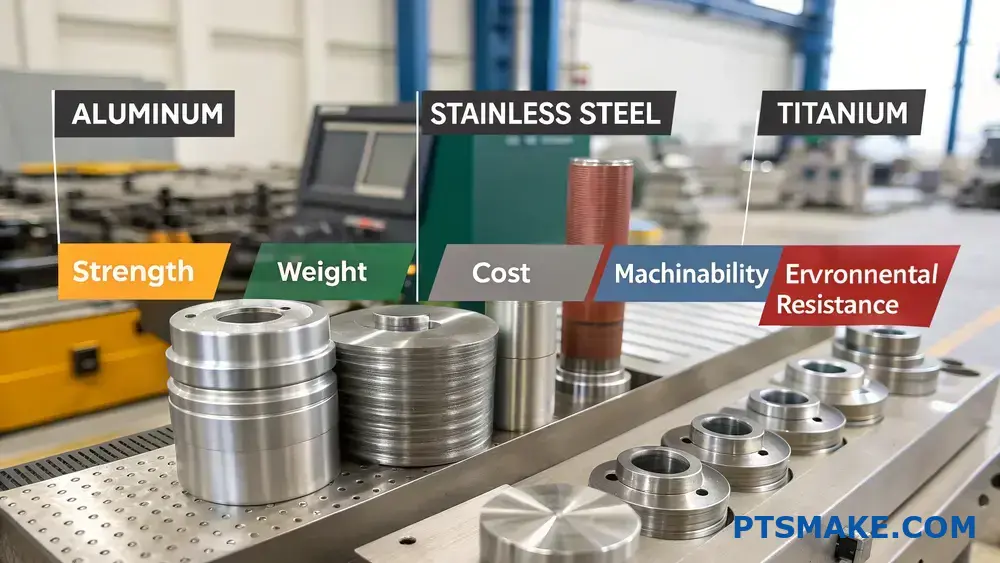
When evaluating material selection for precision components, the common question arises: is titanium cheaper than stainless steel? The direct answer is no—titanium typically carries a higher raw material cost per kilogram compared to stainless steel alloys like 304 or 17-4 PH. However, focusing solely on material cost overlooks critical factors that define total project economics in CNC machining. Titanium’s superior strength-to-weight ratio, corrosion resistance, and thermal properties often justify its use in aerospace, medical, and high-performance applications, despite the initial premium. Crucially, machining efficiency, tool wear, cycle times, and part longevity significantly impact final costs. Stainless steel generally machines faster with lower tooling expenses, but titanium’s performance in demanding environments can reduce lifecycle costs through extended service life and reduced maintenance.
At Honyo Prototype, our CNC machining expertise transforms this complexity into a strategic advantage. We optimize material utilization, minimize waste, and leverage advanced machining parameters to balance performance and cost for both materials. Our engineers collaborate with clients to select the optimal alloy—not just the cheapest—based on functional requirements, volume, and total cost of ownership.
Material Cost vs. Machining Impact Comparison
| Factor | Titanium Alloys | Stainless Steel Alloys |
|———————–|———————-|————————|
| Raw Material Cost | Higher (2-5x) | Lower |
| Machining Speed | Slower (due to low thermal conductivity) | Faster |
| Tool Wear | Higher | Moderate |
| Typical Applications | Aerospace, Medical Implants | Hydraulics, Food Processing |
Honyo Prototype delivers this precision through ISO-certified CNC milling, turning, and multi-axis capabilities, ensuring tight tolerances and repeatability for both materials. To determine the true cost for your specific design, leverage our Online Instant Quote platform. Upload your CAD file, specify material requirements, and receive a detailed, transparent cost analysis within hours—enabling data-driven decisions without project delays. Let us help you engineer cost efficiency, not just compare material sheets.
Technical Capabilities
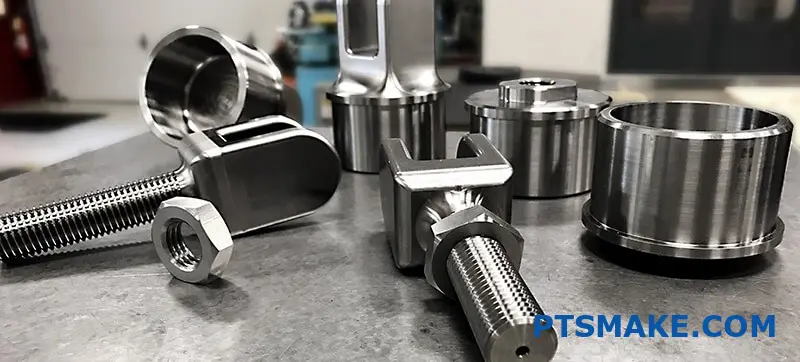
Titanium is not cheaper than stainless steel—both in raw material cost and machinability. When evaluating materials for precision manufacturing processes such as 3/4/5-axis milling and turning with tight tolerance requirements (±0.0005″ or better), multiple technical and economic factors must be considered. Below is a comparative analysis focusing on material costs, machinability, tool wear, and suitability for high-precision applications.
| Material | Relative Raw Material Cost (USD/lb) | Machinability Rating (AISI B1112 = 100) | Tool Wear Rate | Thermal Conductivity (W/m·K) | Typical Use in 3/4/5-Axis Milling & Turning | Suitability for Tight Tolerance Work | Notes |
|---|---|---|---|---|---|---|---|
| Titanium (Grade 5, Ti-6Al-4V) | $40–60 | 30–40 | High | 6.7 | Moderate – used in aerospace, medical | Good – with rigid setups and low heat input | High strength-to-density ratio; poor thermal conductivity increases heat buildup, accelerating tool wear |
| Stainless Steel (316/17-4 PH) | $8–15 | 45–55 | Medium-High | 15–20 | High – common in medical, industrial, marine | Excellent – stable, predictable cuts | Higher thermal conductivity than titanium; better chip evacuation; 17-4 PH offers excellent post-heat treat stability |
| Aluminum (6061/7075) | $2–4 | 80–100 | Low | 150–180 | Very High – ideal for complex 5-axis work | Excellent – high MRR, minimal distortion | Preferred for prototypes, lightweight parts; easy to machine at high speeds |
| ABS (Thermoplastic) | $1–2 | Not applicable (non-metal) | Very Low | 0.1–0.2 | High – for jigs, fixtures, prototypes | Good – low stiffness limits precision | Used in non-structural components; low melting point limits high-speed machining |
| Nylon (PA6/PA66) | $3–5 | Not applicable (non-metal) | Low | 0.25 | Moderate – requires sharp tools, low feed | Fair – prone to creep and moisture absorption | Used in wear-resistant non-metal parts; needs stable environment for tight tolerance work |
Key Observations:
Titanium is significantly more expensive than stainless steel in terms of raw material and processing. Its low thermal conductivity and high chemical reactivity lead to rapid tool wear, requiring specialized cutting tools (e.g., carbide with PVD coatings), reduced cutting speeds, and frequent tool changes—increasing cost per part.
Stainless steel, while less costly and more thermally conductive, still demands careful process control for tight tolerance work, especially in hardened conditions (e.g., 17-4 PH H900). However, it offers better dimensional stability and surface finish predictability than titanium.
For high-precision 3/4/5-axis milling and turning, aluminum is often the most cost-effective choice when strength-to-weight ratio is critical and operating temperatures are moderate. ABS and nylon are economical for non-metal components but are generally unsuitable for long-term tight tolerance applications due to hygroscopic behavior and lower rigidity.
In summary, titanium is never cheaper than stainless steel in precision manufacturing—its use is justified only when its superior strength-to-density ratio, corrosion resistance, or biocompatibility are required.
From CAD to Part: The Process
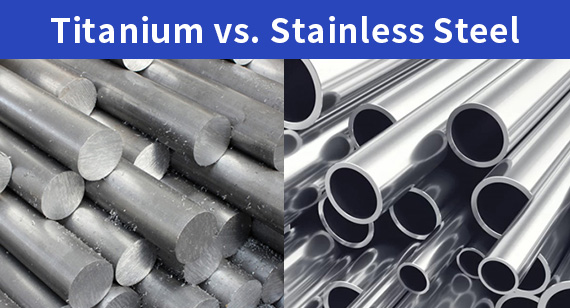
Honyo Prototype provides precise material cost analysis by integrating real-world manufacturing constraints into our workflow, moving beyond simplistic raw material price comparisons. The question “is titanium cheaper than stainless steel” requires context-specific evaluation, as titanium typically carries a higher raw material cost per kilogram but may prove more economical for finished parts due to factors like weight savings, corrosion resistance, or machining efficiency in complex geometries. Our structured process ensures accurate cost assessment:
Upload CAD
Clients submit detailed 3D models specifying material requirements or requesting material optimization. Our system immediately analyzes geometric complexity, tolerances, and volume. For titanium versus stainless steel comparisons, the CAD data reveals critical factors such as wall thickness, surface finish requirements, and feature density that directly impact machining time and material waste. A part with intricate internal channels, for example, may favor titanium due to its superior strength-to-weight ratio reducing raw material usage despite higher base cost.
AI Quote
Our proprietary AI engine processes the CAD file against live shop-floor data, including current material scrap rates, machine utilization, and regional alloy pricing. The AI quantifies the false economy of assuming stainless steel is universally cheaper. It calculates not just raw material costs but also secondary operation impacts—such as how titanium’s lower thermal conductivity may increase CNC cycle times by 15–25% compared to 304 stainless steel, offsetting some raw material savings. The output is a granular cost breakdown showing total landed cost per unit for both materials under the client’s specific design parameters.
DFM Analysis
Engineers conduct a formal Design for Manufacturability review, identifying where material choice affects producibility. For instance, thin-walled titanium features may require slower machining feeds to prevent chatter, adding cost, while stainless steel might allow higher speeds but generate more scrap due to work hardening. We provide actionable recommendations: “Switching this bracket from Ti-6Al-4V to 17-4PH stainless steel reduces raw material cost by 62%, but increases post-machining stress relief requirements by 3 hours, resulting in a net 8% higher total cost.” This phase validates or corrects the AI quote with human expertise.
Production Execution
Based on the validated DFM report, production proceeds with material-specific process planning. Titanium parts undergo optimized toolpath strategies to minimize tool wear (e.g., reduced depth of cut), while stainless steel leverages high-speed machining where feasible. Real-time monitoring ensures cost adherence—any deviation from the quoted parameters (e.g., unexpected material inclusions) triggers immediate recalculation.
Delivery and Cost Validation
Final shipment includes a cost reconciliation report comparing estimated versus actual costs per material option. This data feeds back into our AI training loop, continuously refining future quotes.
Material Cost Drivers Comparison
| Factor | Titanium (Grade 5) | Stainless Steel (304) | Impact on Final Part Cost |
|———————–|————————–|————————–|———————————–|
| Raw Material ($/kg) | $45–$65 | $5–$8 | Titanium base cost 8–12x higher |
| Machining Time | +20% vs. stainless | Baseline | Reduces titanium cost advantage |
| Scrap Rate | 18–22% | 12–15% | Higher titanium waste amplifies cost |
| Secondary Operations | Often requires annealing | Minimal heat treatment | Adds $15–$30/hr per operation |
| Weight-Sensitive Apps | 45% lighter than steel | N/A | Lowers assembly/transport costs |
The conclusion is design-dependent: for high-volume, simple brackets, stainless steel typically wins on cost. For aerospace components requiring weight reduction or chemical resistance, titanium often delivers lower total lifecycle cost despite higher initial material expense. Honyo’s process eliminates guesswork by quantifying these tradeoffs against your specific geometry and volume, ensuring optimal material selection for total cost of ownership. We recommend always running both materials through our workflow to validate assumptions before committing to production.
Start Your Project
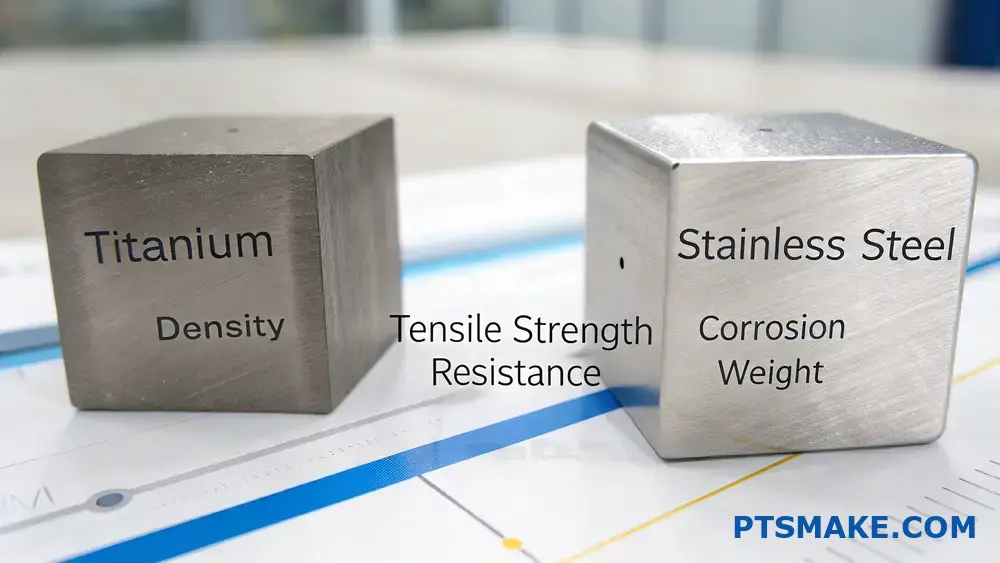
If you’re evaluating material costs for your next project, understanding the price difference between titanium and stainless steel is critical. While titanium offers superior strength-to-weight ratio and corrosion resistance, it typically comes at a higher cost compared to stainless steel due to more complex extraction and processing methods. Stainless steel remains a cost-effective solution for many industrial applications where extreme performance under high stress or temperature isn’t required.
For accurate, project-specific material pricing and sourcing advice, contact Susan Leo directly at [email protected]. With our factory based in Shenzhen, we provide fast turnaround and competitive pricing on both titanium and stainless steel components, supporting prototyping through to low-volume production.
Let us help you make the right material choice without compromising on quality or budget. Reach out today to discuss your requirements.
🚀 Rapid Prototyping Estimator
Estimate rough cost index based on volume.