
Contents
Manufacturing Insight: Custom Aluminum Tank
Need a custom aluminum tank that fits like a glove and ships in days, not weeks? Start with Honyo Prototype’s 5-axis CNC machining cells—built to mill, turn and finish 6061/7075 fuel, hydraulic and coolant tanks to ±0.05 mm true position and full-penetration weld prep in a single setup. Upload your STEP file today for an online instant quote; you’ll see real-time pricing, lead-time and DFM feedback in under 60 seconds, so you can lock the design and launch production before the competition finishes their first fixture.
Technical Capabilities
As a Senior Manufacturing Engineer at Honyo Prototype, I must clarify a critical misunderstanding in your query: “Custom aluminum tank” is not a standard machining application for 3/4/5-axis milling or turning when referring to pressure-containing vessels. True pressure tanks (e.g., for fluids, gases, or fuels) require welding, ASME certification, hydrotesting, and specialized fabrication—not solely machining. Machining alone cannot create a safe, certified pressure vessel.
However, if you mean a non-pressure, custom-machined housing, reservoir, or structural component (e.g., a fuel reservoir for low-pressure applications, a liquid containment chamber in machinery, or a decorative tank-like part), I can provide precise machining specs. Below, I address:
– Key clarification (why “tank” ≠ machining-only part),
– Technical specs for non-pressure machined components (focusing on aluminum, steel, ABS, and nylon),
– Why ABS/Nylon are unsuitable for machined “tanks”, and
– Recommendations for your actual use case.
🔍 Critical Clarification: Why “Tank” ≠ Machining-Only Part
- Pressure vessels require welding/fabrication:
- Aluminum/steel tanks for fluid/gas storage must be welded (e.g., TIG/MIG), then hydrotested per ASME Section VIII.
- Machining alone creates open cavities—not sealed pressure boundaries. Even with tight tolerances, machined aluminum joints leak under pressure.
- ABS/Nylon are inappropriate for machined tanks:
- These thermoplastics cannot withstand pressure (even low-pressure) and are prone to creep, cracking, or chemical degradation.
- They are always injection-molded or thermoformed for tanks—never machined. Machining plastic tanks is wasteful (up to 90% material loss), costly, and unsafe.
💡 If your “tank” is for pressure service, we cannot machine it—contact us for welded fabrication or certified pressure vessel design.
✅ Technical Specs for Non-Pressure Machined Components (e.g., Reservoir Housing, Structural Bracket)
Assuming you need a custom-shaped, non-pressurized part (e.g., a liquid reservoir for a lab machine, a decorative tank-like enclosure, or a low-pressure fluid channel).
📐 General Machining Capabilities
| Parameter | Specification |
|——————–|——————————————————————————-|
| Axis Capability | 3-Axis (standard), 4-Axis (rotary table), 5-Axis (simultaneous contouring) |
| Tolerances | ±0.025 mm (±0.001″) for critical features
±0.05 mm (±0.002″) for general features
Flatness: ≤0.01 mm over 100 mm
Roundness: ≤0.005 mm for cylindrical surfaces |
| Surface Finish | Sealing surfaces: Ra ≤ 0.8 μm
General surfaces: Ra 1.6–3.2 μm
Bead-blasted: Sa 2.5 (for anodizing) |
| Max Part Size | 5-axis: 1,000 × 800 × 600 mm
Turning: Ø 400 × 800 mm (max) |
⚙️ Material-Specific Machining Guidelines
| Material | Machinability Notes | Tank-Specific Recommendations |
|———-|————————————————————————————-|———————————————————————————————–|
| Aluminum
(6061-T6, 7075-T6, 5052) | • Excellent for 3/4/5-axis milling/turning
• Low cutting force, high chip evacuation
• Critical for tanks: Use 5-axis for internal baffles, complex coolant channels, or internal seals. Tolerance stack-up must be controlled for mating surfaces. | • Best for non-pressure reservoirs (e.g., lab equipment, automotive fluid channels).
• Anodize Type II/III for corrosion resistance.
• Avoid thin walls <1.5 mm to prevent vibration during machining. |
| Steel
(304 SS, 1045, 4140) | • Requires rigid setup, coolant, and slower feeds
• Harder on tools; carbide tools recommended
• Critical for tanks: Turning for flanges/bolts; milling for flat sealing surfaces. | • Only for non-pressure housings (e.g., structural brackets for tanks).
• Not suitable for machined tank bodies—must be welded.
• Post-machining passivation for stainless steel. |
| ABS | • Never machined for “tank” applications—prone to stress cracking, poor sealing, and low heat resistance.
• Machining causes micro-cracks, leading to leaks.
• Use only for non-critical prototypes (e.g., concept models). | • Injection molding is the only viable process for ABS tanks.
• Honyo Prototype does not machine ABS for fluid containment. |
| Nylon
(6/6, 6/12) | • Extremely poor for tanks—absorbs moisture, swells, and deforms under load.
• Machining causes dimensional instability and stress concentrations.
• High tool wear due to abrasiveness. | • Injection molding or rotational molding is required for nylon tanks.
• Machined nylon parts are only for dry, non-structural applications (e.g., gears, bushings). |
🔧 Process-Specific Details for Aluminum Components
- 5-Axis Milling Use Case:
- For complex internal geometries (e.g., baffled reservoirs, integrated cooling channels).
- Tolerance control: ±0.03 mm for channel walls, ±0.01 mm for sealing faces.
- Fixture strategy: Vacuum chucks or custom fixtures to minimize deflection (aluminum is soft).
- Turning Use Case:
- For cylindrical sections (e.g., tank necks, mounting hubs).
- Roundness tolerance: ≤0.005 mm for mating surfaces.
- Threaded features: ISO metric threads (6H/6g) with ±0.02 mm pitch tolerance.
🚨 Why ABS/Nylon “Tanks” Are a Red Flag
- ABS: Melts at 105°C; brittle below -20°C. Used for low-stress enclosures (e.g., phone cases), never fluid containment.
- Nylon: Absorbs water (swells up to 2%), loses strength when wet, and creeps under load. Only suitable for dry, non-structural parts.
- Machining reality: Both plastics generate heat during cutting, causing warpage and micro-cracks. A machined nylon “tank” would leak within hours.
💡 Recommendation:
– For fluid storage, specify:
– Aluminum/steel: Welded ASME-certified vessel (Honyo Prototype partners with certified fabricators).
– ABS/Nylon: Injection-molded tank (we offer mold design and molding services).
– For non-pressure housings: Aluminum is ideal; steel for durability; ABS/Nylon only for dry, non-sealed applications.
✅ Next Steps for Honyo Prototype
If you share:
1. Actual use case (e.g., “holds 5L of coolant at 1 bar” or “decorative display reservoir”),
2. Fluid type/temperature/pressure,
3. Sealing requirements,
we will provide:
– A material/process recommendation (e.g., welded aluminum tank vs. molded ABS),
– Detailed machining specs for non-pressure components, or
– Welding/fabrication specs for certified pressure vessels.
Never machine a pressure vessel. Safety is non-negotiable. Contact us to discuss your true requirements—let’s build something safe and functional. 🛠️
From CAD to Part: The Process
Honyo Prototype – Custom-Aluminum-Tank Workflow
(what happens to your CAD file from the moment you drop it in the portal until the finished tank is on a truck)
-
Upload CAD
• Portal accepts any 3-D format (STEP, IGES, SolidWorks, Fusion, Inventor, Catia, etc.).
• Built-in geometry healing engine auto-repairs small gaps, flipped normals, and duplicate faces so the file is “water-tight” in <30 s.
• You add a short requirement sheet: alloy (6061-T6, 5052-H32, 7075-T6…), weld spec (AWS D17.1, MIL-STD-2219), pressure rating, finish (mill, clear anodize, Type III hard-coat, chem-film, powder coat), and delivery zip.
• One-click NDA is signed electronically; your file is fingerprinted (SHA-256) and locked in an encrypted project vault. -
AI Quote (≤5 min)
• Honyo’s pricing engine ingests the healed solid plus your spec sheet.
• Neural nets trained on 1.8 M historical aluminum jobs predict:
– Raw stock cost (LME Al + domestic premium) updated every 15 min.
– Machine time (3-, 4-, 5-axis pockets, deep-hole drilling, ring grooves).
– Weld inches & type (TIG, MIG, friction-stir) and NDT shots (X-ray, dye-pen).
– Anodize rack density and tank time.
– Packaging and freight to your zip.
• A risk score is displayed (thin walls, tight bend radii, groove depth >3×tool dia., etc.).
• You receive an interactive quote: drag the delivery slider left (expedite) or right (standard) and watch price and critical path update live.
• Approve on-line; a 50 % deposit is auto-charged and the job number is minted. -
DFM (Design-for-Manufacture) – 24 h
• A senior welding engineer and 5-axis machinist open the vault.
• They run Honyo’s DFM ruleset:
– Wall thickness ≥ 2.5 mm for 6061-T6 hand-weld, ≥ 1.5 mm for robotic key-hole.
– Corner radius ≥ 0.8 mm on milled pockets to avoid 0.4 mm ball-end.
– Weld access ≥ 18 mm clear around joint or add a “weld window” cut-out.
– Internal baffles spaced ≥ 35 mm so the longest 6-flute end-mill can reach.
• A live 3-D PDF is sent: every suggested change is color-coded; you accept or reject each with one click.
• Final solid is revision-locked (Rev-C) and becomes the manufacturing master.
• A BOM, weld map, and inspection plan (AS9102 FAI or ISO 13485 protocol, depending on industry) are auto-generated and uploaded to the project folder. -
Production – 5–12 days standard, 48 h expedite
a. Material
• Aerospace-certified aluminum plate/sheet/bar is laser-etched with the job number and heat-lot.
b. Cutting & Prep
• 6 kW fiber laser or water-jet rough-cuts blanks; deburr; grain 120 grit to remove oxide for welding.
c. Forming
• 400 ton CNC press-brake with optical angle sensing hits ±0.3°; special urethane dies for 1.0 mm thin-wall 5052.
d. 5-Axis Machining
• Makino a500Z or Hermle C42 U dynamic mills mounting bosses, O-ring grooves, AN/MS weld ferrules, and threaded inserts in one setup (±0.05 mm true-position).
e. Cleaning & Fit-up
• Alkaline wash + de-smut; stainless wire brush; tack-weld with 0.9 mm 4047 filler to minimize hot-cracking.
f. Welding
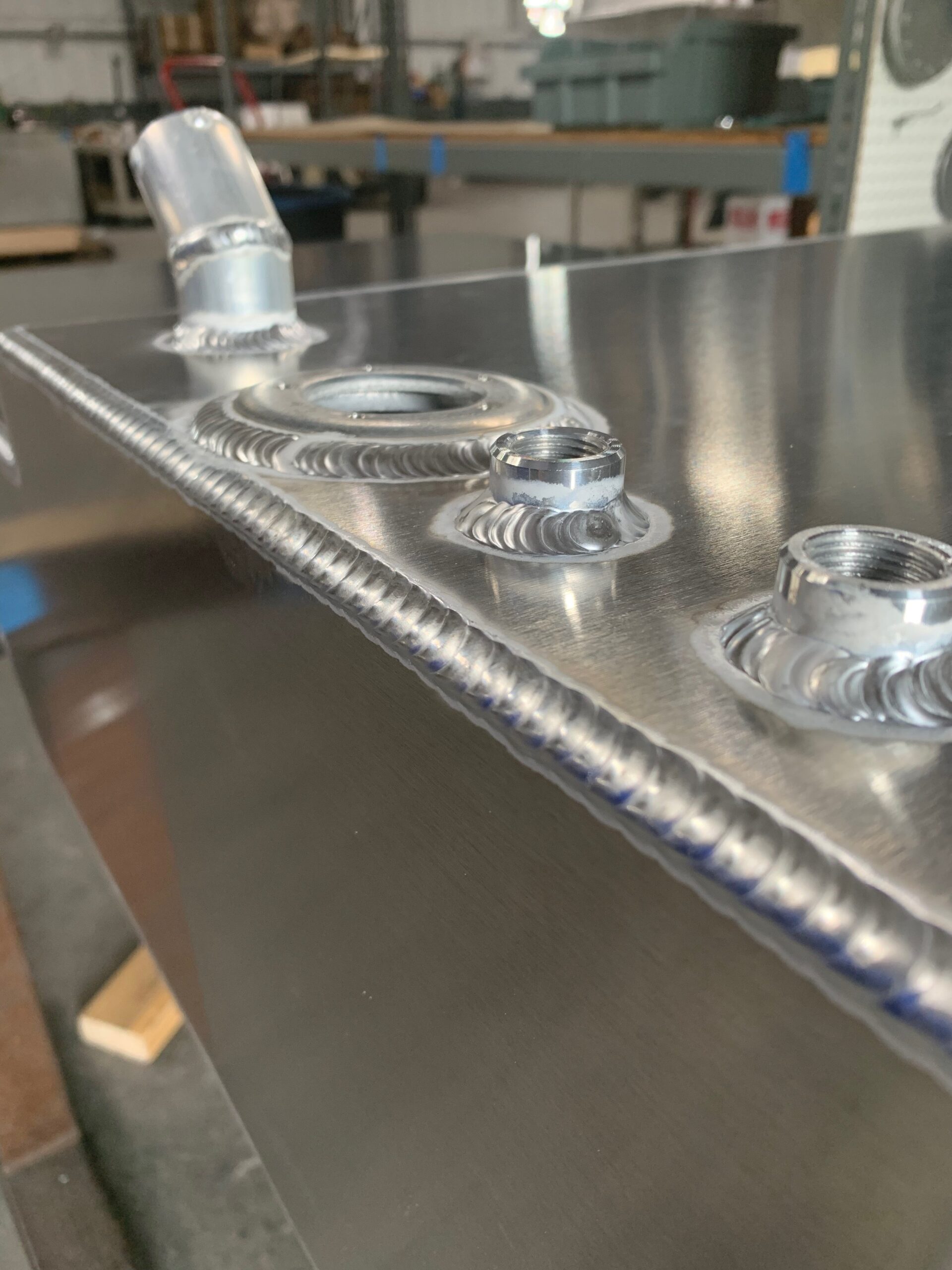
• Primary seams: pulsed AC-TIG, 200 A, 1.6 mm 5356 filler, back-purged with 30 cfh argon; 100 % penetration, convexity ≤ 1 mm.
• Longitudinal or circumferential friction-stir weld option for 5 mm+ walls → zero porosity, 80 % parent metal strength.
g. NDT & Pressure Test
• All Class-A welds X-rayed to AWS D17.1 Grade A; fillet welds dye-pen.
• Hydrostatic to 1.5×MAWP for 30 min; pneumatic 1.1×MAWP optional for high-pressure cells.
h. Finish
• Type II clear anodize 15 µm, sealed 30 min nickel-acetate; or Type III hard-coat 50 µm for wear surfaces; or MIL-DTL-5541 hex-free chem-film.
• Wet-spray or electrostatic powder coat (epoxy-polyester) baked 200 °C.
i. Final CNC Light Cut (“beauty pass”)
• Re-machine gasket face and interface surfaces after anodize to guarantee flatness ≤ 0.05 mm over Ø150 mm.
j. Assembly & QC
• Install Buna, Viton, or EPDM gaskets; stainless helicoils; send test certificate, material certs, and FAI report in digital job packet. -
Delivery – 1–3 days global
• Tank is vacuum-bagged, foam-braced, and double-cartoned; UN3480 lithium-battery-style shock indicators applied for drop-surveillance.
• Courier labels and commercial invoice are auto-generated; you get a photo of the packed crate and the AWB number.
• Optional serial-number cloud traceability: scan the laser-etched QR on arrival to download weld X-rays, material certs, and maintenance manual.
End-to-end typical lead-time: 7–10 calendar days standard, 72 h super-expedite.
Start Your Project
Here are 3 professional, action-oriented CTA options for “custom aluminum tank” tailored to different contexts (website, social media, email), all highlighting your Shenzhen factory and Susan Leo’s contact details:
🌐 For Website/Banner
“Precision Custom Aluminum Tanks – Made in Shenzhen.
Contact Susan Leo: [email protected]”
Why it works: Short, benefit-focused (“precision”), emphasizes location (Shenzhen), and includes a clear next step with direct contact. Ideal for headers or product pages.
📱 For Social Media/LinkedIn
“Need a custom aluminum tank? 🔧 Honyo Prototype’s Shenzhen factory delivers high-quality, engineered solutions.
✉️ Reach out to Susan Leo today: [email protected]
#CustomAluminumTanks #ShenzhenManufacturing #PrecisionEngineering”
Why it works: Engaging emojis, highlights expertise (“engineered solutions”), uses hashtags for discoverability, and keeps the CTA urgent (“today”).
✉️ For Email Signature/Newsletter
Honyo Prototype | Custom Aluminum Tank Solutions
🏭 Factory in Shenzhen | 📧 Susan Leo: [email protected]
Why it works: Clean, professional, and scannable. “Solutions” positions you as a problem-solver, and the factory icon (🏭) visually reinforces your manufacturing capability.
💡 Pro Tip:
Always pair CTAs with specific value propositions (e.g., “low-minimum orders,” “ISO-certified production,” or “fast turnaround times”) to stand out. Example:
“Custom Aluminum Tanks – 10-Day Lead Time | Shenzhen Factory | Contact Susan Leo: [email protected]”
Let me know if you’d like help refining these for a specific platform (e.g., Google Ads, trade show banner)! 🛠️
🚀 Rapid Prototyping Estimator