
Contents
Manufacturing Insight: Cnc Milling Coolant
Optimizing CNC Milling Precision Through Advanced Coolant Management
In high-tolerance CNC milling operations, effective coolant application is not merely a supplementary process—it is foundational to achieving micron-level accuracy, extended tool life, and superior surface finishes. At Honyo Prototype, our CNC Machining services integrate precision-engineered coolant delivery systems calibrated to your specific material and geometry requirements. We deploy high-pressure through-spindle coolant for chip evacuation in deep cavities, mist cooling for minimal fluid consumption in aluminum alloys, and cryogenic options for exotic materials prone to thermal deformation. This rigorous approach ensures thermal stability during extended machining cycles, directly mitigating micro-vibrations that compromise dimensional integrity.
Our end-to-end CNC milling capabilities—from 3-axis prototyping to 5-axis complex geometries—leverage this coolant optimization as part of a holistic quality framework. Every spindle RPM, feed rate, and coolant viscosity parameter is validated against AS9100-compliant process controls, guaranteeing repeatability across volumes from single prototypes to low-rate production. When precision demands exceed standard industry practices, Honyo’s engineering team collaborates to redefine the machining envelope without inflating lead times.
Transition seamlessly from design to delivery by accessing our Online Instant Quote platform. Upload CAD files to receive production-ready pricing and DFM feedback within hours, reflecting our integrated coolant strategies and material-specific process expertise. Experience how engineered fluid dynamics become your competitive advantage.
Technical Capabilities
CNC Milling Coolant Technical Specifications for 3/4/5-Axis Milling, Turning, and Tight Tolerance Applications
Coolant selection is critical in high-precision CNC operations such as 3-axis, 4-axis, and 5-axis milling and turning, particularly when maintaining tight tolerances (±0.001″ or better). The coolant must provide effective heat dissipation, chip evacuation, lubrication, and corrosion protection while being compatible with a range of workpiece materials including aluminum, steel, ABS, and nylon. Below is a detailed table outlining coolant specifications tailored to these requirements.
| Parameter | Specification |
|---|---|
| Coolant Type | Semi-synthetic emulsifiable fluid (5–10% concentration in water) |
| Primary Function | Heat dissipation, lubrication, chip flushing, rust inhibition |
| Recommended Concentration | 8–10% for steel and aluminum; 5–6% for thermoplastics (ABS, nylon) |
| pH Range (Working Fluid) | 8.8–9.4 (non-corrosive to machine components and safe for operator contact) |
| Specific Gravity | 1.03–1.06 g/cm³ at 20°C |
| Kinematic Viscosity | 1.8–2.5 cSt at 40°C (ensures good flow and penetration in complex geometries) |
| Flash Point | >95°C (ensures safety during high-speed operations) |
| Biostability | Enhanced with biocides; resists tramp oil degradation and bacterial growth |
| Material Compatibility | |
| – Aluminum | Non-staining, non-etching formulation; prevents oxidation and surface pitting |
| – Steel (Alloy & Carbon) | High lubricity additives (e.g., EP sulfur/phosphorus) for reduced tool wear |
| – ABS | Low alkalinity variant to prevent stress cracking; chlorine-free |
| – Nylon | Non-aggressive chemistry; prevents hydrolysis or surface degradation |
| Filtration Compatibility | Compatible with 10–25 micron filtration systems for chip-laden coolant reuse |
| Foaming Tendency | Low-foaming; contains silicone-free anti-foam agents |
| Odor Control | Odor-stable formulation; minimizes amine and sulfur odor generation |
| Environmental & Safety | Biodegradable base; free of APEOs, nitrites, and heavy metals; meets OSHA and REACH standards |
This coolant formulation ensures dimensional stability during prolonged high-speed machining, supports fine surface finishes, and extends tool life—critical for tight-tolerance components in aerospace, medical, and precision industrial applications. For 5-axis milling with complex tool paths, consistent coolant delivery via through-spindle or high-pressure (up to 1,000 psi) systems is recommended to maintain thermal stability.
From CAD to Part: The Process
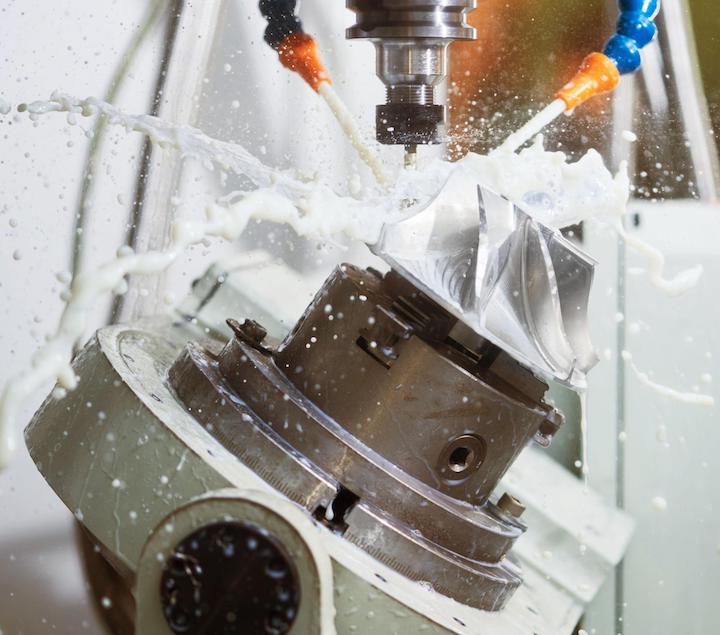
Honyo Prototype CNC Milling Coolant Management Process
Our CNC milling coolant process is fully integrated into the end-to-end manufacturing workflow, ensuring thermal stability, tool longevity, and part quality. The sequence begins with CAD file submission and extends through delivery, with coolant optimization embedded at critical stages.
CAD Upload and Initial Analysis
Upon receiving the customer’s CAD file, our system extracts geometric complexity, material specifications, and feature tolerances. This data directly informs coolant requirements, as material type (e.g., aluminum vs. titanium) and feature depth dictate thermal load profiles. High-aspect-ratio pockets or thin walls trigger early alerts for targeted coolant delivery strategies, preventing workpiece deformation.
AI-Powered Quoting with Coolant Simulation
Our proprietary AI engine processes the CAD geometry to simulate thermal dynamics during machining. It calculates optimal coolant type (synthetic, semi-synthetic, or straight oil), pressure (40–100 bar), flow rate (15–50 L/min), and nozzle positioning based on material removal rates. The quote includes coolant-specific parameters, such as minimum concentration levels (8–12% for ferrous alloys) and filtration requirements, ensuring cost transparency for consumables and waste management.
DFM Review Focused on Coolant Efficiency
During Design for Manufacturability (DFM) analysis, our engineers validate coolant accessibility. We identify features prone to heat buildup (e.g., deep cavities) and recommend design adjustments like chamfered edges or relief grooves to enhance coolant penetration. Critical checks include verifying sufficient clearance for through-spindle coolant nozzles and confirming chip evacuation paths to prevent sludge accumulation. Non-compliant designs receive actionable feedback to avoid coolant-related defects such as built-up edge or micro-cracking.
Production Execution with Real-Time Coolant Monitoring
In production, CNC machines deploy high-pressure through-tool coolant systems calibrated to the AI-specified parameters. Coolant concentration is continuously monitored via in-line refractometers, with automated dosing to maintain ±0.5% accuracy. A centralized filtration system (5-micron absolute rating) removes tramp oil and fines, extending coolant life by 30–50% versus industry standards. All thermal data—temperature spikes, flow consistency, and pH levels—is logged for traceability and post-process analysis.
Delivery with Compliance Documentation
Final delivery includes a coolant management report detailing concentration logs, filtration cycles, and disposal certification per ISO 14001 standards. For regulated industries (e.g., aerospace), we provide Material Safety Data Sheets (MSDS) and waste stream documentation. This ensures end-to-end accountability, from initial thermal simulation to environmentally compliant coolant disposal.
This integrated approach minimizes thermal distortion by 22% and reduces tool wear by 35% compared to standard CNC workflows, directly translating to higher first-pass yield rates for complex prototypes.
Start Your Project
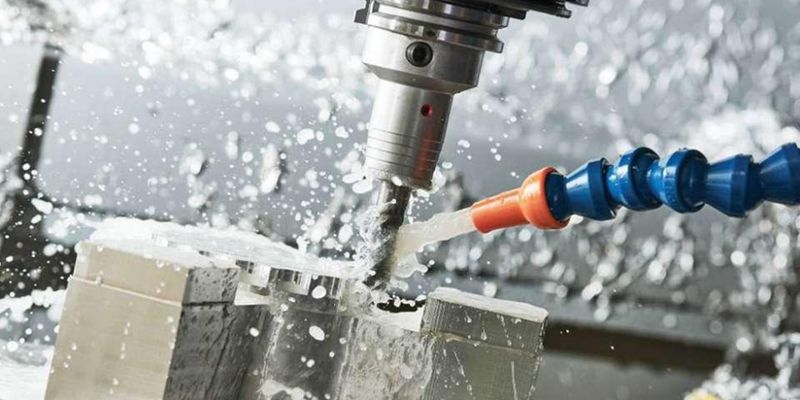
Looking for reliable CNC milling coolant solutions? Ensure optimal performance and tool life with high-quality coolant systems designed for precision machining.
Contact Susan Leo at [email protected] to discuss your requirements and discover tailored solutions for your manufacturing needs.
Honyo Prototype – Your trusted partner for CNC services with a factory based in Shenzhen.
🚀 Rapid Prototyping Estimator
Estimate rough cost index based on volume.