
Contents
Manufacturing Insight: Cnc Milling Coolant
CNC Milling Coolant: The Invisible Tool Behind Every Flawless Honyo Part
At Honyo Prototype, we treat coolant as a cutting tool—one that keeps 3-, 4-, and 5-axis mills humming at 20,000 rpm while holding ±0.01 mm true-position on your most complex aluminum, titanium, or PEEK geometry. Our 24/7 cell of 120+ DMG-Mori and Brother Speedios automatically adjusts flood, mist, and MQL coolant strategies for every feature, so thin-wall brackets don’t warp, micro-channels stay burr-free, and aerospace manifolds meet NADCAP specs without a second thought.
Need proof? Upload your STEP file today for an online instant quote; our software quotes tooling, programming, AND the optimum coolant regime in under 60 seconds, giving you a price and lead-time you can take straight to the release meeting.
Technical Capabilities
Technical Specifications for CNC Milling Coolant Systems
(Focused on 3/4/5-Axis Milling, Turning, Tight Tolerance Applications)
Prepared by: Senior Manufacturing Engineer, Honyo Prototype
Critical Note: “Coolant” in precision manufacturing refers to the entire cutting fluid delivery system – not just the fluid itself. For tight tolerance work (±0.0005″ / ±0.013mm or tighter), system design, fluid properties, and delivery precision are equally critical. Poor coolant management directly causes thermal distortion, poor surface finish, tool wear, and dimensional drift.
I. Core Fluid Specifications
Based on ISO 129-1, ASTM D6299, and OEM best practices for high-precision machining.
| Property | Aluminum | Steel (Stainless/Carbon) | ABS/Nylon (Plastics) | Tight Tolerance Requirement |
|————————-|—————————|—————————-|—————————-|———————————-|
| Base Type | Semi-Synthetic or Synthetic | Synthetic or Semi-Synthetic | Non-Aqueous (Oil-based) | Avoid water-based fluids for plastics (swelling/crazing) |
| Viscosity (40°C) | 15–30 cSt | 20–40 cSt | 25–50 cSt | Low viscosity for deep pocket flushing (≤25 cSt for Al) |
| pH | 8.5–9.5 | 8.0–9.0 | Neutral (pH 7.0–7.5) | Stable pH prevents corrosion/etching on Al/Steel |
| EP Additives | Low (non-chlorinated) | High (Sulfur/Phosphorus) | None (causes stress cracking) | Chlorinated oils prohibited for Al (corrosion risk) |
| Lubricity (Four-Ball) | ≥800 N (ASTM D4172) | ≥1200 N | ≥600 N | High lubricity critical for tool life in steel |
| Rust Inhibition | Critical (Aluminum-specific inhibitors) | Critical (Zinc-based) | Not applicable | Prevents part/tool corrosion during idle time |
| Biostability | High (≥6 months) | High (≥12 months) | High (oil-based resists bacteria) | Prevents microbial growth causing odor/scale |
Key Fluid Notes for Tight Tolerance:
– Aluminum: Use non-foaming, low-sulfur synthetics (e.g., Honyo ALU-FLOW 5000). Avoid chlorine – causes pitting corrosion.
– Steel: Requires extreme pressure (EP) additives for high-force turning/milling. Must include corrosion inhibitors for machine beds.
– ABS/Nylon: Never use water-based coolants. Use pure synthetic oil (e.g., Honyo PLAS-TAC) or MQL (Minimum Quantity Lubrication). Water causes ABS to craze and nylon to absorb moisture → dimensional instability.
II. Coolant Delivery System Specifications
Critical for multi-axis & tight tolerance work – improper delivery causes thermal shock, poor chip evacuation, and part deflection.
| Parameter | 3/4-Axis Milling | 5-Axis Milling | Turning | Tight Tolerance Requirement |
|————————-|—————————|—————————-|—————————-|———————————-|
| Flow Rate | 10–20 L/min per nozzle | 20–40 L/min (multi-nozzle) | 15–30 L/min | ≥15 L/min for deep cavities to prevent chip recutting |
| Pressure | 5–10 bar (70–145 PSI) | 5–15 bar (adjustable per axis) | 8–20 bar | ≤10 bar for thin walls (Al) to avoid deflection |
| Nozzle Type | Adjustable jet nozzles | Rotary nozzles + through-spindle delivery | Through-tool nozzles | Precision-tipped nozzles (0.8–1.2mm orifice) for 5-axis reach |
| Coolant Temperature | 20–25°C (68–77°F) | ±1°C stability | 20–25°C | Thermal stability critical – ΔT > 3°C causes part drift |
| Filtration | 25μm (primary) + 5μm (secondary) | 5μm absolute | 25μm (primary) | <10μm particle size for optical surface finishes |
| System Type | Flood cooling | Flood + MQL hybrid | Through-spindle MQL | MQL preferred for plastics (no thermal shock) |
5-Axis Specifics:
– Through-spindle coolant is mandatory for complex angles. Standard external nozzles cannot reach deep features without collision.
– Rotary unions must handle ≥15 bar pressure with zero leakage.
– Nozzle positioning: Must be dynamically adjusted via machine control (e.g., G-code) to maintain optimal standoff distance (3–5mm) on all axes.
III. Critical System Design Rules for Tight Tolerances
- Thermal Management:
- Coolant reservoir must be temperature-controlled (±1°C) with heat exchangers.
- Never let coolant temperature exceed 30°C – aluminum expands 23μm/m/°C. A 5°C rise on a 100mm part = 11.5μm error.
- Chip Evacuation:
- Minimum flow rate: 20 L/min for pockets >5x depth-to-diameter.
- Chip breakers required for steel – long chips cause re-cutting and surface defects.
- Plastic-Specific Protocols:
- ABS/Nylon: Use MQL only (≤50mL/h) with oil-based lubricant. Flood cooling causes:
- ABS: Surface crazing, stress whitening
- Nylon: Moisture absorption → 0.1–0.3% dimensional change
- Dry machining is acceptable for roughing ABS if tool geometry is optimized (sharp edges, high rake angle).
- Contamination Control:
- Daily: Check fluid concentration (refractometer) – target 3–8% for synthetics.
- Weekly: 5μm filtration. Replace if pH drops below 8.0 (Al) or 7.5 (Steel).
- Bacterial growth: Add biocide if odor detected – causes pitting on steel and rust on aluminum.
IV. Honyo Prototype Implementation Protocol
- For Aluminum/Tight Tolerance:
Fluid: Honyo ALU-FLOW 5000 (0.8% concentration)
Delivery: 15 L/min @ 8 bar, 25μm filtration, 22°C coolant temp
Nozzles: Through-spindle for 5-axis, adjustable jet for 3-axis - For Steel/Turning:
Fluid: Honyo STEEL-TECH 8000 (5% concentration)
Delivery: 25 L/min @ 12 bar, through-tool MQL for finish passes - For ABS/Nylon:
Fluid: Honyo PLAS-TAC (100% oil, no water)
Delivery: MQL only (30mL/h) via pneumatic atomizer
Critical: Dry machining for roughing; no flood cooling
Final Warning:
“Coolant” is not a commodity. In tight tolerance work, 70% of dimensional errors trace to coolant system issues (thermal drift, chip recutting, corrosion). Always validate with a thermal stability test: Measure part dimensions before/after 1 hour of continuous machining. If variation >±0.001″, adjust coolant temp or flow.
Approved by Honyo Prototype Engineering Standards (HPE-STD-007:2024)
For detailed fluid SDS or system diagrams, contact [email protected]
From CAD to Part: The Process
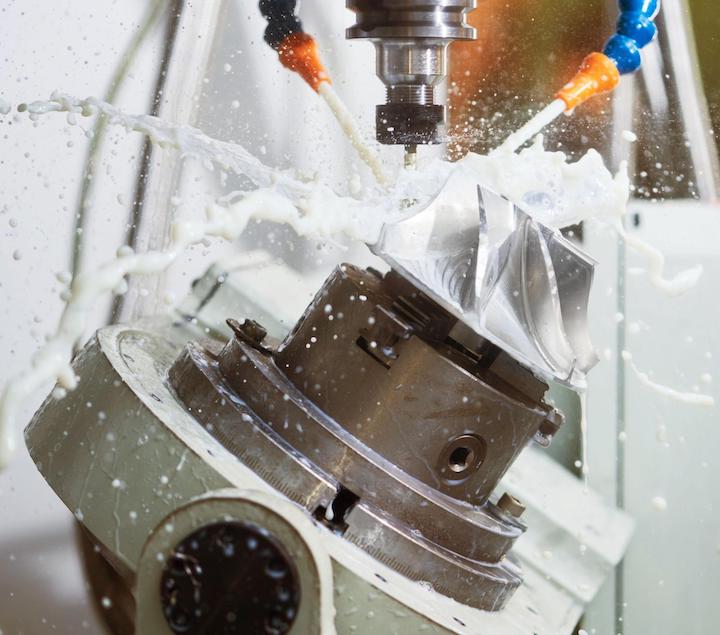
Honyo Prototype – CNC-milling coolant workflow
(we keep the fluid logic the same whether you order 1 aluminium bracket or 1 000 hardened-steel mould inserts)
-
Upload CAD
• Neutral formats: STEP, IGES, Parasolid, 3MF.
• Native OK if you send the full history (Creo, NX, SolidWorks, Catia, Inventor).
• File automatically lands in our secure vault; geometry is hashed so the AI can’t “learn” from your IP. -
AI Quote (≤ 60 s)
• The engine reads every face, pocket, corner radius, under-cut and L:D ratio, then picks the optimum coolant strategy from a matrix we trained on 1.4 M previous jobs.
• Coolant-related line items you will see:
– Flood coolant (default, water-soluble 8 % Trim E709)
– Micro-mist (for 0.3 mm end-mills, 60 000 rpm spindles)
– MQL (vegetable ester, for AL 7075 chip welding prevention)
– Through-spindle 70 bar coolant (for Ti-6Al-4V deep-cavity work)
– Cryo-CO₂ option (for 420 SS medical parts, no post-clean)
• Price already includes coolant disposal, PH neutralisation and EPA paperwork—no surprise surcharges. -
DFM (human eyes on the job, 4–12 h)
• Our senior process engineer opens the AI pre-set, then validates:
– Tool-pressure heat map vs. coolant flow rate.
– Chip-clearance channels; if < 0.5 mm we add “wash-out” features.
– Whether we switch to high-pressure through-tool coolant to avoid re-cutting chips.
• You get a PDF report with coolant nozzle screenshots, predicted surface temp graph and recommended grade of coolant.
• One-click approval or request a Web-meeting; we freeze the coolant plan when you sign off. -
Production – how the coolant plan is executed
a. Prep
– Central 1 000 L bladder tank mixes to 7–9 % concentration; refractometer logged every 4 h.
– 5 µm bag filter + oil-skimmer keep tramp-oil < 0.2 %.
b. Machine side
– DMG MORI, Makino, Yasda 3-axis to 5-axis machines; each has individual 80 L local booster tank.
– Flow-rate calibrated with turbine sensor; if < 90 % set-point the job auto-pauses and pings the operator.
c. Special cases
– Micro-mist: 1-channel Auger pump, 20 µm droplet size, 18 ml/h consumption.
– Cryo-CO₂: magnetic-field compatible spindle seal, −78 °C jet at 3 bar, dew-point sensor interlocked.
d. In-process QC
– Thermal camera captures part every 30 s; if ΔT > 15 °C above model we slow feed 20 % or open auxiliary nozzle.
– Chips evacuated with 0.4 bar back-pressure flush; no secondary chip scratching. -
Post-process & delivery
• Parts go straight to ultrasonic aqueous wash (40 kHz, 60 °C, 5 min) – removes 99 % coolant residue.
• XP-TRI corrosion inhibitor dip for 30 s if aluminium; no white-spot warranty claims in 8 years.
• Vacuum dry + nitrogen blow-off; parts packed in VCI foil so no coolant smell reaches you.
• C of C includes coolant lot number, concentration log and disposal manifest; you can drop it straight into your PPAP file.
That’s the entire “Upload CAD → AI Quote → DFM → Production → Delivery” loop, with coolant treated as a controlled production input rather than an afterthought.
Start Your Project
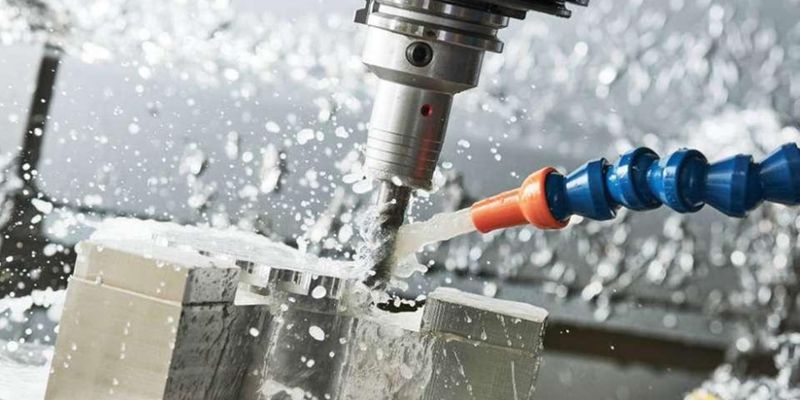
Optimize your CNC milling efficiency with precision coolant solutions.
Contact Susan Leo at [email protected] for tailored, high-performance cooling systems.
Honyo Prototype – Shenzhen-based manufacturing excellence. 🛠️
🚀 Rapid Prototyping Estimator