
Contents
Manufacturing Insight: Cnc Aluminum Keyboard Case
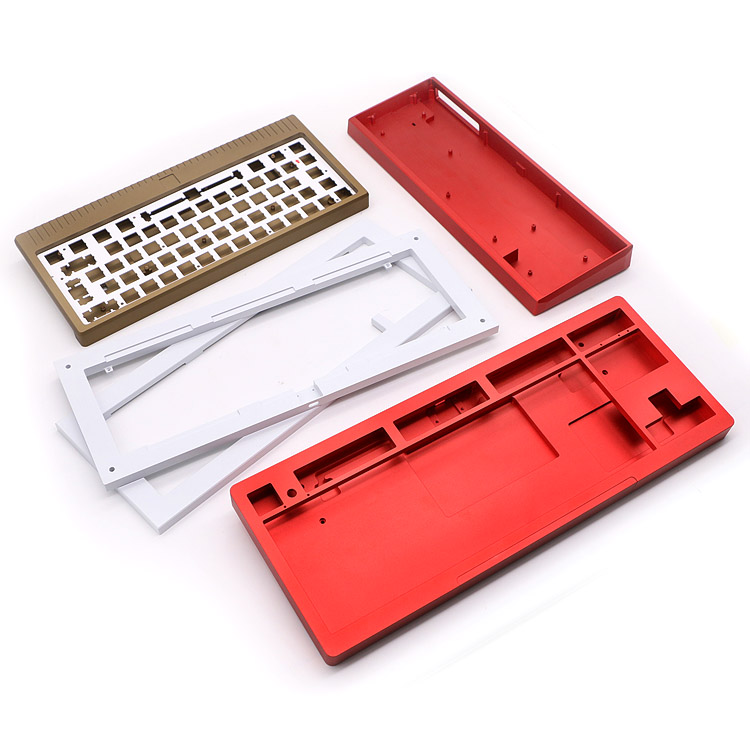
Precision Aluminum Keyboard Cases Engineered for Performance
Honyo Prototype delivers exceptional CNC-machined aluminum keyboard cases that merge structural integrity with exacting aesthetic standards. Our advanced 5-axis CNC machining capabilities ensure micron-level tolerances (±0.005mm) across complex geometries, critical for seamless PCB and stabilizer integration in high-end mechanical keyboards. Utilizing aerospace-grade 6061-T6 and 7075-T6 aluminum alloys, we achieve optimal thermal dissipation, vibration damping, and long-term dimensional stability—key requirements for premium keyboard manufacturers seeking durability without compromise.
Every case undergoes rigorous in-process inspection and surface finish optimization, including bead blasting, anodizing compatibility, and custom engraving options. Our process eliminates common pitfalls like warping or inconsistent wall thickness, directly addressing the precision demands of custom keyboard designers. As a full-spectrum prototype-to-production partner, Honyo reduces lead times by 30% through integrated workflow management and dedicated engineering support from DFM analysis to final assembly.
Accelerate your product development cycle with our Online Instant Quote platform. Upload CAD files to receive detailed pricing, lead time estimates, and manufacturability feedback in under 60 seconds—no sales calls required. This transparent, engineer-driven quoting system empowers keyboard brands to iterate faster and scale confidently.
| Key Capability | Application Benefit |
|---|---|
| 5-Axis Simultaneous Machining | Complex undercuts, seamless contours, and internal features without secondary operations |
| Tight Tolerance Control (±0.005mm) | Perfect PCB alignment, consistent keycap stability, and zero wobble |
| Anodizing-Ready Surface Finish | Uniform dye absorption for custom color finishes and enhanced corrosion resistance |
| Rapid Prototyping to Low-Volume Production | Validate designs in 5–7 days; transition smoothly to batch production |
Technical Capabilities
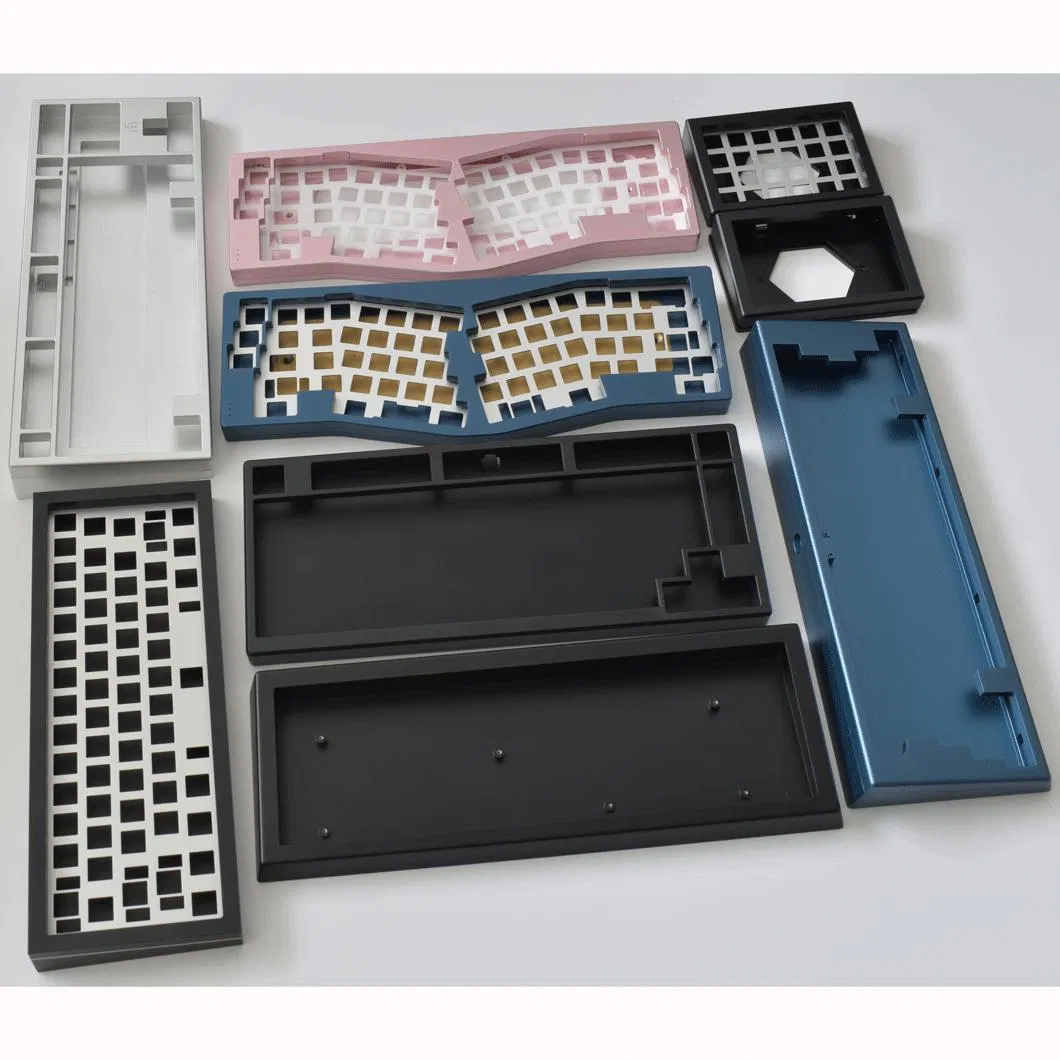
CNC aluminum keyboard cases are precision-machined enclosures designed for mechanical keyboards, combining structural rigidity, thermal conductivity, and aesthetic finish. These components are typically manufactured using multi-axis CNC milling and turning operations to achieve complex geometries and tight dimensional tolerances. Below are the technical specifications relevant to the manufacturing process, materials, and performance criteria.
Manufacturing Process Overview
| Process | Description | Typical Applications | Key Capabilities |
|---|---|---|---|
| 3-Axis CNC Milling | Traditional milling along X, Y, and Z linear axes. Suitable for flat or 2.5D geometries. | Basic case shells, simple undercuts | ±0.005″ (0.13 mm) tolerance, surface finish Ra 32–64 μin |
| 4-Axis CNC Milling | Adds rotational A-axis (X-axis rotation). Enables machining of curved or angular features without re-fixturing. | Side-mounted USB cutouts, angled mounting points | ±0.003″ (0.076 mm) tolerance, improved feature alignment |
| 5-Axis CNC Milling | Simultaneous movement across three linear (X, Y, Z) and two rotational (A, B) axes. Allows full 3D contouring. | Complex ergonomic shapes, seamless chamfers, integrated mounting rails | ±0.001″ (0.025 mm) tolerance, surface finish Ra 16–32 μin |
| CNC Turning | Used for cylindrical or symmetrical components (e.g., knob inserts, threaded standoffs). | Fasteners, alignment pins, bushings | Diameter tolerance ±0.0005″ (0.013 mm), concentricity <0.001″ |
Material Specifications
| Material | Typical Use in Keyboard Case | Machinability | Thermal & Mechanical Properties | Notes |
|---|---|---|---|---|
| Aluminum (6061-T6) | Primary case body, top/side plates | Excellent; ideal for high-speed milling | High strength-to-weight ratio, good thermal conductivity, corrosion-resistant | Most common; anodizing compatible |
| Aluminum (7075-T6) | High-stress structural inserts or reinforcement | Good, but harder to machine than 6061 | Higher strength, fatigue resistance | Used in performance-focused builds |
| Stainless Steel (303/316) | Mounting brackets, screws, standoffs | Moderate; generates more tool wear | Excellent durability, corrosion resistance | Used where higher rigidity is required |
| ABS (Acrylonitrile Butadiene Styrene) | Internal frames, mounting plates (rarely CNC’d) | Good for low-speed trimming | Moderate impact resistance, lightweight | Typically injection molded, not CNC primary |
| Nylon (PA6, PA66) | Bushings, dampeners, custom key stabilizer parts | Moderate; prone to melting if not cooled | High wear resistance, low friction | CNC-machined for precision inserts |
Tolerance and Surface Quality Requirements
| Parameter | Standard | High-Precision Build |
|---|---|---|
| Dimensional Tolerance | ±0.005″ (±0.13 mm) | ±0.001″ (±0.025 mm) |
| Positional Tolerance (Holes, Cutouts) | ±0.003″ (±0.076 mm) | ±0.0015″ (±0.038 mm) |
| Surface Finish (Ra) | 32–64 μin | 16–32 μin (polished to 8 μin if anodized) |
| Flatness | 0.003″ over 4″ span | 0.001″ over 4″ span |
Notes on Finishing and Assembly
Post-machining processes such as deburring, bead blasting, and anodizing (Type II or Type III) are standard for aluminum cases to enhance corrosion resistance and aesthetics. Tight tolerance alignment ensures compatibility with PCBs, plate mounts, and stabilizers. Multi-axis setups reduce part handling, improving geometric consistency across critical interfaces.
From CAD to Part: The Process
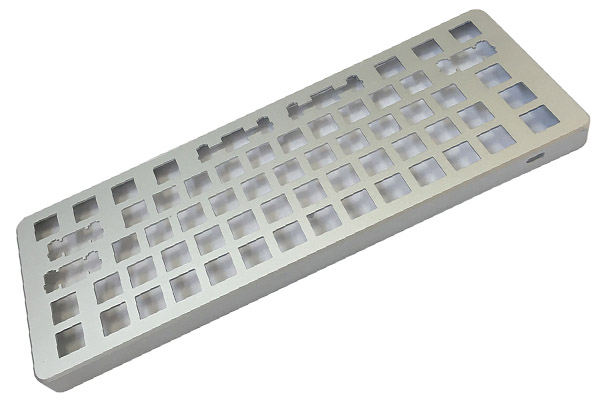
Honyo Prototype CNC Aluminum Keyboard Case Manufacturing Process
Honyo Prototype executes a streamlined, quality-focused workflow for CNC aluminum keyboard case production, integrating digital efficiency with precision engineering. The process begins when a client uploads their CAD model to our secure portal. We accept STEP, IGES, and native formats (e.g., SolidWorks, Fusion 360), with strict validation for unit consistency (metric preferred), watertight geometry, and feature completeness. Incomplete or non-standard files trigger immediate client notification to prevent downstream delays.
AI-Powered Quoting Engine
Upon CAD validation, our proprietary AI system generates an instant preliminary quote within 2 hours. This system dynamically factors in real-time variables: aluminum alloy grade (6061-T6 or 7075 standard), raw material costs, machine time estimates from historical production data, anodizing requirements (e.g., Type II or III), and surface finish specifications (e.g., bead blast Ra 0.8–1.6 μm). The quote includes a breakdown of material, machining, finishing, and logistics costs, with clear annotations for non-standard features like ultra-thin walls (<1.0 mm) or complex undercuts. A Honyo applications engineer reviews all AI outputs to validate feasibility before client delivery.
Engineering-Led DFM Analysis
Post-quote approval, our manufacturing engineering team conducts a rigorous Design for Manufacturability (DFM) review within 48 hours. This phase identifies and resolves critical issues:
Wall Thickness Validation: Ensuring minimum 0.8 mm for structural integrity during milling and anodizing
Tolerance Stack-Up Analysis: Verifying ±0.05 mm alignment for PCB mounting pins and switch cutouts
Tool Access Assessment: Flagging internal radii requiring specialized tooling (e.g., 1 mm ball end mills)
Anodizing Impact Review: Adjusting tolerances for 5–25 μm oxide layer growth
Fixture Strategy: Proposing custom vacuum or modular jig solutions to prevent chatter on thin profiles
The DFM report includes actionable recommendations with annotated CAD markups, requiring client sign-off before proceeding.
Precision Production Execution
Approved designs enter production on our dedicated CNC cell:
1. Material Prep: Aerospace-grade 6061-T6 billet stress-relieved and inspected for grain structure
2. 5-Axis Machining: Haas UMC-750 machines perform roughing, semi-finishing, and finishing in a single setup to maintain ±0.025 mm positional accuracy
3. In-Process Inspection: CMM checks at critical stages (e.g., after cavity milling, pre-anodizing) using Zeiss CONTURA
4. Surface Finishing: Custom bead blasting followed by Type III hard anodizing (25–50 μm thickness) with color dyeing per Pantone standards
5. Final Validation: 100% functional testing for PCB fitment and switch stability, plus batch anodizing thickness verification
Guaranteed Delivery Framework
All orders ship with serialized traceability via our PLM system. Standard lead time is 12–15 business days from DFM approval, inclusive of:
72-hour production scheduling (prioritized by delivery commitment)
7-day machining/finishing cycle with real-time client portal updates
48-hour final inspection and packaging (anti-static foam, custom labeling)
Global logistics coordination with DHL/FedEx, including customs documentation for international shipments
We maintain a 99.2% on-time delivery rate through dynamic capacity allocation across our Shenzhen and Dongguan facilities, with expedited 7-day options available for critical prototypes.
This integrated approach ensures keyboard cases meet mechanical, aesthetic, and functional requirements while minimizing time-to-market—a critical advantage for mechanical keyboard OEMs in competitive markets.
Start Your Project
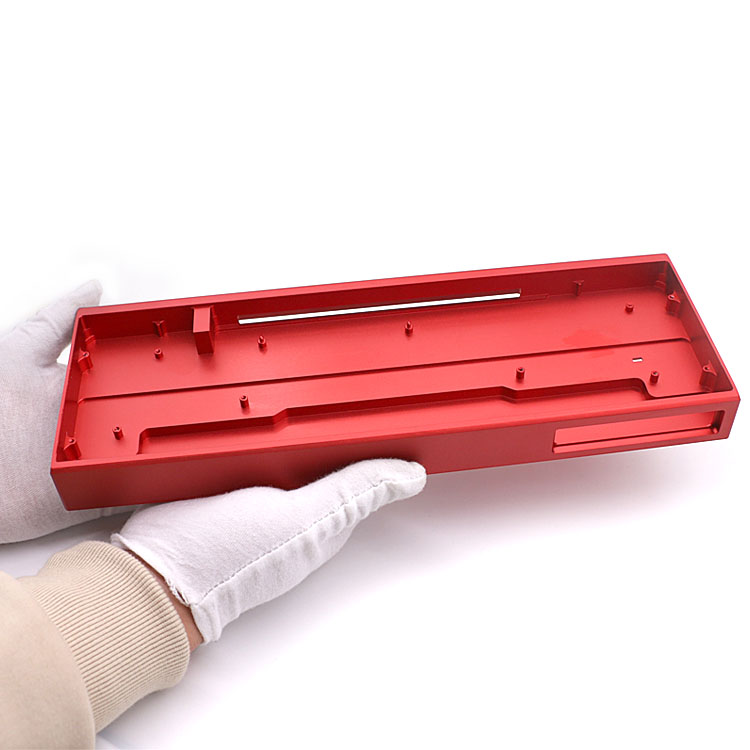
Interested in high-precision CNC aluminum keyboard cases manufactured to your exact specifications? Contact Susan Leo at [email protected] to discuss your project.
Honyo Prototype operates a dedicated manufacturing facility in Shenzhen, China, specializing in custom CNC-machined aluminum enclosures for mechanical keyboards. Our in-house capabilities ensure rapid prototyping, strict quality control, and scalable production for low to medium volumes.
From design support to finish machining—including anodizing, engraving, and custom tolerances—we deliver durable, aesthetically precise cases built for performance and reliability.
Reach out today to request a quote or technical consultation.
Contact: Susan Leo
Email: [email protected]
Factory Location: Shenzhen, China
🚀 Rapid Prototyping Estimator
Estimate rough cost index based on volume.