
Contents
Manufacturing Insight: Aluminum Die Casting Machine
Honyo Prototype delivers precision aluminum die casting solutions where near-net-shape geometry meets stringent engineering requirements. While aluminum die casting efficiently produces complex, high-integrity components with excellent mechanical properties and surface finish, achieving final critical dimensions, tight tolerances, and specific functional surfaces often necessitates secondary machining. Raw castings may require precise hole drilling, face milling, thread cutting, or intricate feature definition beyond the capabilities of the casting process alone due to factors like draft angles, ejector pin marks, or parting line mismatches.
This is where Honyo’s integrated CNC Machining services provide critical value. Our advanced 3-, 4-, and 5-axis CNC milling and turning centers are specifically optimized to handle post-casting operations on aluminum alloys. We seamlessly transition cast components into fully finished, production-ready parts, ensuring adherence to exact geometric dimensioning and tolerancing (GD&T) specifications, achieving surface finishes down to Ra 0.8 µm, and maintaining critical positional accuracy. Our manufacturing engineers collaborate closely during the casting design phase to optimize part geometry for both casting feasibility and efficient CNC machining, minimizing secondary operation costs and lead times.
For engineers and procurement teams seeking rapid validation of this integrated capability, Honyo Prototype offers an Online Instant Quote system. Simply upload your CAD model (STEP, IGES, Parasolid) specifying both the die casting requirements and any necessary CNC machining operations. Our platform provides immediate, transparent pricing and lead time estimates for the complete value stream – from molten metal to precision-machined component – accelerating your prototyping and low-volume production decisions. Leverage Honyo’s combined die casting and CNC expertise to transform your aluminum component designs into high-performance reality.
Technical Capabilities
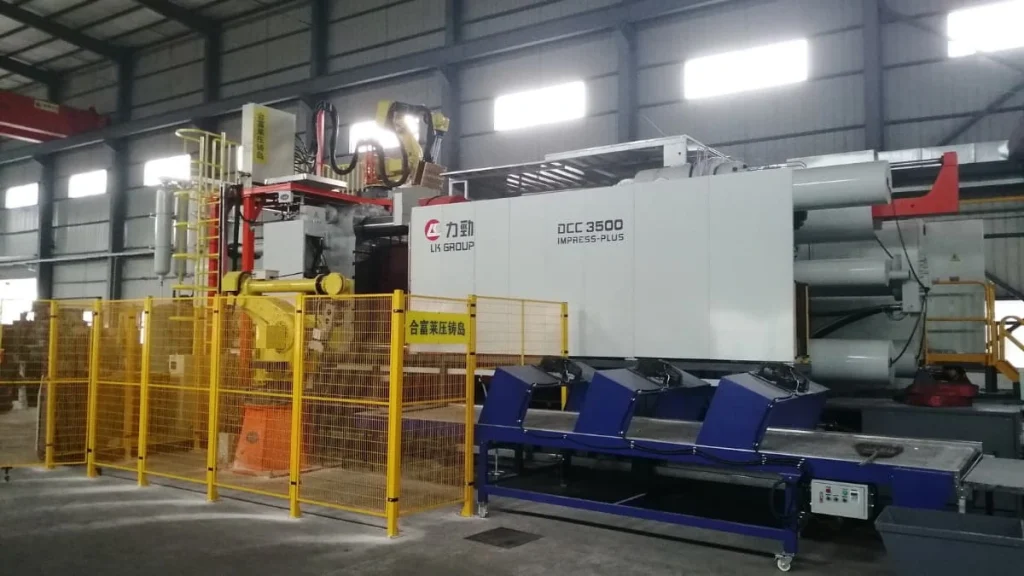
The term “aluminum die casting machine” refers to equipment used in the high-pressure die casting (HPDC) process to produce aluminum components by injecting molten metal into a steel mold under high pressure. However, the processes mentioned—3/4/5-axis milling, turning, and tight tolerance machining—are post-casting operations typically performed on CNC machining centers, not on the die casting machine itself.
Below is a technical specification table for a CNC Machining Center commonly used for post-processing aluminum die cast parts, with capabilities in multi-axis milling, turning, tight tolerances, and compatibility with a range of materials including aluminum, steel, ABS, and nylon.
| Parameter | Specification |
|---|---|
| Machine Type | 5-Axis CNC Machining Center (with optional turning capability – mill-turn) |
| Axis Configuration | X, Y, Z linear axes + A and C rotary axes (full 5-axis simultaneous machining) |
| Spindle Speed | 15,000 – 30,000 RPM (high-speed for aluminum and plastics) |
| Positioning Accuracy | ±0.005 mm (±0.0002 in) |
| Repeatability | ±0.002 mm (±0.0001 in) |
| Tool Magazine Capacity | 24–60 tools (automatic tool changer) |
| Rapid Traverse Rate (X/Y/Z) | 60 m/min (2,360 in/min) |
| Control System | Fanuc, Siemens, or Heidenhain CNC with 5-axis interpolation |
| Work Envelope (X×Y×Z) | 800 × 600 × 500 mm (31.5 × 23.6 × 19.7 in) – typical range |
| Maximum Part Weight | Up to 1,000 kg (2,200 lbs) with rotary table support |
| Minimum Achievable Tolerance | ±0.01 mm (±0.0004 in) for aluminum; ±0.012 mm for engineering plastics |
| Surface Finish (Typical) | Ra 0.8–3.2 µm (machined aluminum); Ra 1.6–6.3 µm (plastics) |
| Compatible Materials | Aluminum alloys (e.g., A380, 6061, 7075), Tool Steel, Stainless Steel, ABS, Nylon (PA6, PA66), PEEK |
| Coolant System | High-pressure through-spindle coolant (for aluminum and steel); air cooling recommended for plastics |
| Chip Management | Automatic chip conveyor and filtration system |
| Automation Ready | Yes (compatible with robotic loading/unloading for high-volume production) |
Notes:
Aluminum die cast parts often require CNC machining to achieve tight tolerances and critical feature accuracy.
3/4/5-axis milling allows complex geometries to be machined in fewer setups, improving precision and reducing cycle time.
Turning operations are integrated in mill-turn centers, enabling complete machining of rotational features without secondary operations.
Materials like ABS and nylon can be machined on the same platform but require reduced speeds, specialized tooling, and avoidance of coolant (use air blast instead).
Tight tolerance machining (±0.01 mm) is achievable with thermal compensation, high rigidity, and in-process probing.
From CAD to Part: The Process
Honyo Prototype executes aluminum die casting projects through a rigorously defined five-stage workflow designed for precision, speed, and technical accountability. This integrated process ensures manufacturability while minimizing time-to-market for client prototypes and low-volume production runs.
CAD Upload and Validation
Clients initiate the process by uploading native or neutral format CAD files (STEP, IGES, Parasolid) via our secure portal. Our engineering team immediately performs geometric validation against ISO 10283 standards, checking for critical factors including minimum wall thickness compliance (≥1.2mm for AlSi10Mg), draft angle sufficiency (≥1° per side), and undercuts requiring complex core pulls. Invalid geometries trigger automated notifications with specific correction guidelines before proceeding.
AI-Powered Quoting Engine
Validated CAD data feeds into our proprietary AI quoting system, which analyzes 150+ technical parameters including part volume, projected area, complexity factor, and gate design requirements. The system cross-references real-time data from our die casting cell: aluminum alloy pricing (A380, A360, ADC12), machine availability, and labor rates. Quotes include detailed cost breakdowns for tooling (steel grade selection impact), secondary operations, and NRE charges within 4 business hours, eliminating manual estimation errors.
Engineering-Driven DFM Analysis
Quotes trigger mandatory Design for Manufacturability review by senior die casting engineers. This phase employs MAGMAsoft® simulation to predict fill patterns, solidification behavior, and porosity risks. We provide actionable reports with specific recommendations such as:
Localized wall thickness adjustments to prevent shrinkage
Optimal gate location and size calculations
Ejection system modifications to avoid part distortion
Thermal management solutions for die longevity
Client approval of the DFM report is required before tooling fabrication begins.
Precision Production Execution
Approved projects move to our dedicated die casting cell featuring state-of-the-art machinery. Production adheres to strict process controls:
| Machine Parameter | Standard Capability | High-Precision Capability |
|---|---|---|
| Clamping Force Range | 400-2000 tons | 800-1600 tons |
| Shot Speed | 3-5 m/s | 4.5-6.5 m/s (controlled) |
| Molten Metal Temp. Ctrl | ±15°C | ±8°C |
| Cycle Time Monitoring | Real-time SPC | AI-based anomaly detection |
All castings undergo in-process verification per AS9102 B forms, including first-article dimensional reports (FAIR) and porosity checks via X-ray per ASTM E505 Level 2 requirements. Secondary operations like CNC machining, heat treatment (T6), and surface finishing occur in controlled cleanrooms.
Traceable Delivery and Documentation
Completed orders ship with full material traceability documentation including:
Heat-treated alloy certificates (chemical composition per ASTM B806)
Dimensional inspection reports (CMM data against original CAD)
Process parameter logs (shot speed, pressure curves, cycle times)
Non-destructive test results
Parts are packaged using anti-corrosion VCI film and custom foam cradles to prevent transit damage. Standard lead time from DFM approval to delivery is 15-20 business days for tooling and first articles, with expedited options available. We provide real-time logistics tracking and post-delivery technical support for assembly or integration challenges.
This closed-loop methodology ensures technical rigor at every phase while maintaining the agility required for prototype and bridge production applications. Clients receive not just parts, but fully validated manufacturing data to de-risk their scale-up to volume production.
Start Your Project
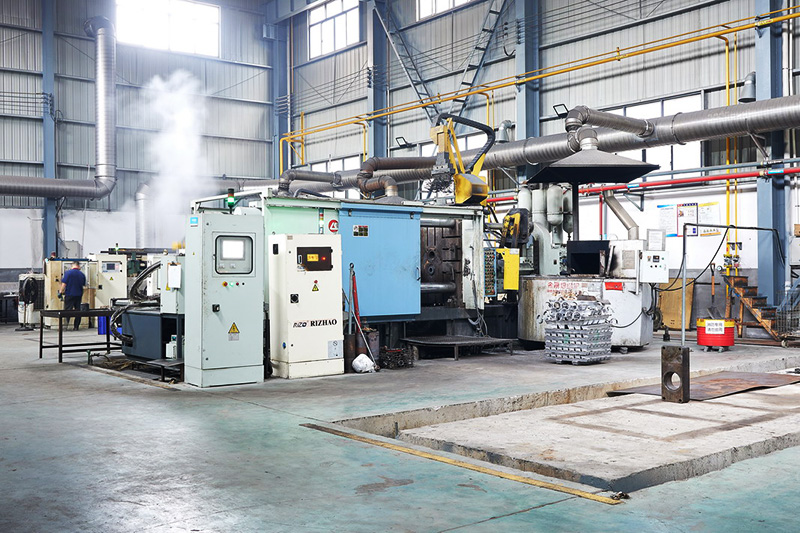
Interested in high-performance aluminum die casting machines built for precision and durability? Contact Susan Leo today to discuss your manufacturing needs and discover how our advanced die casting solutions can enhance your production efficiency.
Email Susan Leo at [email protected] to request technical specifications, pricing, or a direct consultation.
All machines are manufactured and rigorously tested at our Shenzhen factory, ensuring strict quality control and adherence to international standards. Partner with a trusted source in aluminum die casting technology—reach out now to get started.
🚀 Rapid Prototyping Estimator
Estimate rough cost index based on volume.